We have ordered some of these new breeds.Please call for special orders.
New Breeds Hatching in 2020!
        
\
      | ||||
Monday, January 13, 2020
New Breeds from Mt. Healthy Hatchery

Thursday, January 9, 2020
The 2020 Chick Season is HERE! Get Started with Baby Chicks!
A Beginner’s Guide to Raising Baby Chicks
Where to Buy Baby Chicks and What to Do When They're Home

Where to Buy Baby Chicks
Local Farmers: Owners of small backyard flocks often breed their birds and sell either fertile eggs or fluffy hatchlings. Some operate small breeding programs while others just sell mixed-breed stock. Purchasing from local farmers gives you the advantage of meeting someone who already knows how to raise baby chicks. They’re usually willing to give advice and may even take back babies with genetic defects. Purchasing and raising baby chicks from members of your community can help build your own homesteading circle. But as with all purchases, be wary. Decide what you want before you buy: pure breeds or healthy mixed breeds. Ask the farmer about genetic lines, what illnesses he’s dealt with, and his policies if the babies aren’t healthy.Hatcheries: For decades, chicks have shipped safely via the postal service. If they are handled correctly, those that die are babies that would have perished anyway. Purchasing from hatcheries is a well-accepted way to obtain the breeds you want. Hatcheries hire personnel trained in baby chick identification to separate cockerels from pullets and keep each breed distinct. Some hatcheries specialize in show quality poultry while others pride themselves on variety. Still others publish online tutorials or print brochures about raising baby chicks. Reputable companies reimburse you for chicks that perish before you pick them up from the post office. Others guarantee their pullets with 90% accuracy, refunding for any males above that 10% discrepancy. But ordering from several states away carries risks, as well. Some only ship after March because a journey in a cold mail truck can be hazardous. Others charge high shipping rates to guarantee the safety of the babies. Before purchasing online, research which hatcheries had problems with salmonella or which are located in areas prevalent with avian flu.
Feed Stores: If you want to see and select the babies firsthand, visit a feed store. From March to May, most farm suppliers also stock newly hatched poultry. Some even offer free chick day, the one day out of the year when you can receive a few free babies with each bag of feed purchased. You can observe the chicks before you buy, watch how they move around and sleep, check for spraddle legs or pasting, and try to determine males from females. The babies go home with you that day and you can purchase heat lamps and feeders at the same time. Experienced personnel can give you advice regarding raising baby chicks. Feed stores can be a one-stop shopping experience for new backyard chicken owners. But not all feed stores are created equally. Most will not accept chicks back after they’ve left the store. Nor will they refund you for males that were misidentified as pullets. Some stores are more diligent about animal health than others. So many farmers and chicken owners walk through their doors each day that diseases such as chronic bronchitis can transmit unseen on the soles of shoes.
All the Right Supplies
Before the chicks arrive home, be sure you have the right equipment. You’ll need:- A high-sided container to use as a brooder. This can be a plastic tote, for small flocks, or refrigerator boxes for larger batches.
- A heat lamp to keep the environment almost 100 degrees. You might want to also consider a thermometer.
- Bedding, such as pine shavings. Do not use newspaper or magazines because babies can slip and injure their legs. Cedar shavings are toxic and can damage chicks’ lungs.
- A waterer. Pet bowls or kitchen pans are dangerous because chicks can fall inside and drown, get chilled, or poop inside. Purchase a waterer designed for raising baby chicks, either online or at a feed store. Consider adding clean marbles to the reservoir during the first week to avoid accidents.
- A feeder. Again, don’t use just any old dish. The babies will climb inside, spill the food, and poop everywhere. A baby chick feeder is difficult to tip, only allows heads to enter and keeps the food clean.
- Chick feed. Many starter feeds are medicated to prevent coccidiosis, a common disease that can distress adult birds and quickly kill baby chicks. If you’re also raising ducks or geese, purchase non-medicated feed for the waterfowl.
- Chickens have no teeth and cannot chew their food. Grinding action occurs within the gizzard, with the aid of gravel. Chickens living outside can eat sand and rocks, but if you’re raising baby chicks without a mother hen you need grit. Purchase clean chick grit from a feed store or get canary gravel from the supermarket pet aisle.
- A grate or net. The babies are only tiny and helpless for a short time. They quickly grow wings and flap out of brooders. Soon you’ll need to cover the top with a barrier such as an oven rack or bird netting, securing it to the brooder so it doesn’t fall in on the babies and keeping it away from the heat lamp.
Bringing Home your Babies
Whether you purchased from a hatchery, feed store, or a local farmer, get your chicks comfortable right away. Set them on clean bedding, with the heat lamp on. Introduce them to their water by dipping beaks in then setting the babies beside the waterer, especially if they just traveled to you in the mail. Most chicks will catch on right away and return for a second drink but you may have to dip beaks again.Watch your babies closely during the first day. If you see a black “string” extending from their rear ends, do not pull it. This is the remnant of the umbilical cord. Let chicks wander around freely within the brooder. Avoid holding them unless you need to assess their health or lead them toward food and water. People new to raising baby chicks often monitor temperatures with a thermometer. Those who have done it a few times simply watch the babies’ behavior; if they’re cold, they’ll huddle up together. When temperatures are too high they move away from the heat lamp and pant with their beaks open.
Keep children and pets away from brooders. Establish boundaries. Babies are tempting to touch, pick up and perhaps eat. Some dogs want to mother the babies and chicks don’t appreciate being licked repeatedly. Others want a simple snack. And though your children wish to be involved in the process of raising baby chicks, they often don’t realize how delicate the hatchlings can be. A drop from eighteen inches up can kill a chick.
How to Raise Baby Chicks
As with human children, the first needs are the simplest. They eat, poop and sleep. Messes are easy to clean up because the birds don’t make them often. But they age and grow.Chicks need the brooder to be 95 degrees during the first week and 90 the second. Each week, move the heat lamp further away to drop the temperature five more degrees. Use the chick’s behavior as your guide. If they move from the heat lamp or lay down and pant when the thermometer says it should be the right temperature, cool it down even more. By the time they feather out at six weeks, they’ll no longer need a heat lamp and can go outside if the weather is decent.
Raising baby chicks requires a lot of vigilance. They kick bedding into their water and poo into the food. Clean this up immediately. Chickens need constant access to clean food and water. Soon you will recognize cries of distress and how they differ from pleas of hunger or simple chirping.
At least once per day, pick them up and observe their vents for pasting up. This is where their feces sticks to their fluffy butts and eventually seals off the vents so they can’t poo any more. Pasting occurs more often in brooder-raised chicks. If the chicks paste up, hold warm, wet washcloths to the vents until you can gently peel away the offending feces. Don’t pull too hard; if it won’t come off easily, soak it longer. Also, don’t allow the entire chick to get wet or it can become chilled. After the droppings are removed, set the chick back under the heat lamp.
Change bedding at least once a week. As they age, so do their metabolisms. That weekly cleaning may become biweekly, or more often if you keep meat breeds. Carefully remove babies and set them in a warm container where they will not slip. A clean towel spread out within a plastic tub works great. Cover the container with a net or grate if necessary. Dump the shavings into the garbage or compost and refill the brooder with new bedding.
Hold your chicks but keep it to a minimum. Especially if children are involved. Some chicken owners have a fifteen-minute rule: no more than fifteen minutes of total handling per day. Too much can distress the baby. A chick that is already sick may never recover.
After a few weeks, the chicks can enjoy brief moments outside. Be sure temperatures are over 65 degrees, it’s not windy and the grass isn’t wet. Use temporary housing to keep them from wandering away and to keep predators out. Portable rabbit cages work well; some companies sell collapsible “play pens” specifically for babies’ outside time. Listen for chirps of distress. And don’t leave them outside too long.
By six weeks they will be ready to go outside. If the weather is favorable, or it’s already summer, they may be able to go out earlier. Provide warm shelter. Don’t expect the chicks to immediately seek shelter when they get cold. They’ll probably stand there and chirp for help, calling you to carry them into the coop. After a while they’ll get the hint but these few weeks of instruction allows you to bond with them.
Backyard chickens are a rewarding experience. Whether you’re raising baby chicks purchased from a feed store, a hatchery, or a local farmer, learn what you need before bringing the chickens home. And don’t be afraid to ask questions at the store or seed information from your favorite poultry magazine. Above all…enjoy!

Tuesday, November 12, 2019
Winter Fun, Prevent Chicken Boredom
10 Winter Boredom Busters for Chickens
Bored chickens are not happy chickens. Bored chickens tend to start pecking at each other and themselves, resulting in feather loss or worse.
Once a flock sees blood, it can whip the chickens into a frenzy and they will sometimes literally kill flock mates.... purely out of boredom and pecking order clashes.
Boredom can also lead to egg eating. Read more HERE about that nasty habit. I've never read anything to prove this next one, but I also think that boredom can result in more broodies being broody longer.
I mean, if there's nothing going on outside and no outdoor 'action' they feel left out of, why NOT just sit in a nesting box all day long?

Once a flock sees blood, it can whip the chickens into a frenzy and they will sometimes literally kill flock mates.... purely out of boredom and pecking order clashes.
Boredom can also lead to egg eating. Read more HERE about that nasty habit. I've never read anything to prove this next one, but I also think that boredom can result in more broodies being broody longer.
I mean, if there's nothing going on outside and no outdoor 'action' they feel left out of, why NOT just sit in a nesting box all day long?
Don't let this happen to your girls. It is the chicken equivalent of human cabin fever. But it's not 'normal' behavior and is easily prevented with proper flock management.
I have never had issues with pecking between our hens, other than the occasional rap on the head that says 'hey, remember your place in the pecking order!'
Boredom is more prevalent in the winter when there aren't weeds and grass to munch on, bugs to eat, butterflies to chase or dirt to bathe in and sun themselves.
Boredom pecking is more likely to happen if your coop and run are too small and the chickens don't have adequate space, so don't be stingy, let those girls have as large a run as possible, and try not to keepthem confined to their coop except on the most frigid, blizzard-y days.
I have never had issues with pecking between our hens, other than the occasional rap on the head that says 'hey, remember your place in the pecking order!'
Boredom pecking is more likely to happen if your coop and run are too small and the chickens don't have adequate space, so don't be stingy, let those girls have as large a run as possible, and try not to keepthem confined to their coop except on the most frigid, blizzard-y days.
Of course treats help keep chickens occupied (read HERE for some creative treat ideas), but too many treats aren't good for them, so here are some non-food ideas for keeping your chickens busy during the long, cold winter months.
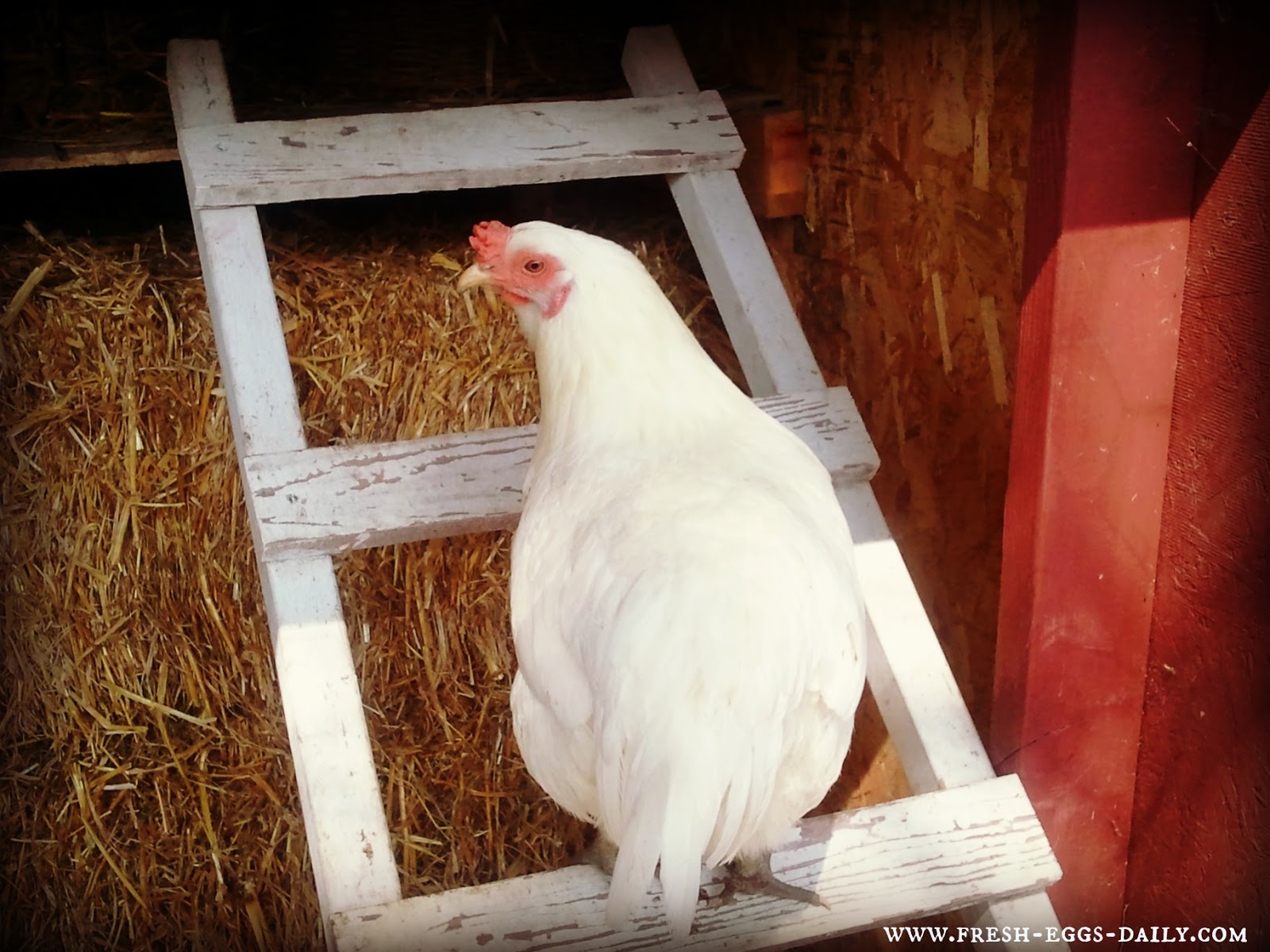


Chickens LOVE to hop up on things and get a 'bird's eye' view. Especially when it's muddy or snowy, but really any time, a chicken will generally seek high ground if possible.
Outdoor roosts can keep them occupied, if not for hours, for at least a little while!
You can use boards, branches, ladders, any variety of things to create a multi-leveled chicken jungle gym of sorts. Or you can get really ambitious and make your girls a swing out of a log.
2. Stumps to Stand On


An added bonus, if you move the stumps periodically or turn them onto their other end, the chickens will have great fun finding the bugs the collect.
3. Piles of Leaves, Straw or Hay


Chickens HATE piles! They will scratch and kick whatever you give them until the pile is no more.
Great fun for the afternoon!
4. Hang a Mirror


Chickens, being the preeners that they are, have a great time looking at themselves in the mirror.
Trust me on this one.
It's well worth a trip to Goodwill to pick up a cheap mirror. Just be sure it's well secured so it can't be knocked over as the girls shove each other aside to check themselves out.
(One note: if you have a rooster, you might want to pass on the mirror - most roosters wouldn't take kindly to another roo in their flock!
5. Anything New and Different


The chickens will naturally come over to investigate.
6. Sheltered Dust Bath Area


If the chickens' regular bath area is covered in snow or mud, try setting up a bath in a sheltered area for them, even in a large tub or kiddie pool that you can put out for them on nice days.
7. Supervised Free Range


The chickens will appreciate being able to stretch their legs, as long as there are some bare patches on the ground where they don't have to walk in the dreaded white stuff!
Fresh air is good for you both! Just be super vigilant because predators are hungry and food sources are scarce this time of year.
8. Enlarge your Run


Give your chickens the largest area to roam that you possibly can so they have enough space to get away for some 'me' time once in awhile.
9. Spend More Time With Them


The more handing of them that you do, the easier it will be to catch and hold one when you NEED to due to illness or injury.
Also time spent with your chickens helps you understand the flock dynamic a bit better, identify any bullies (although with proper management bullies should never be a problem) and is just downright relaxing!
It's easy in the summer to spend time outdoors, but make it a point to bundle up and head to the coop for awhile each day all through the winter as well.
10. Pony Rides
 |
| ~photoshop magic courtesy Kate at Farmhouse38~ |

Okay, just kidding on the pony rides ! But kudos to Kate from Farmhouse38 and her photoshop magic for making this photo totally believable, right?
Okay, so how about ...
10. Seed and Suet Treats or a Lettuce Pinata

Homemade or commercial seed blocks or suet cakes cakes can help relieve winter boredom and also provide some extra nutrition and energy on cold days.
How about a Seed and Nut Wreath (pictured above)....
...or some Suet Cakes
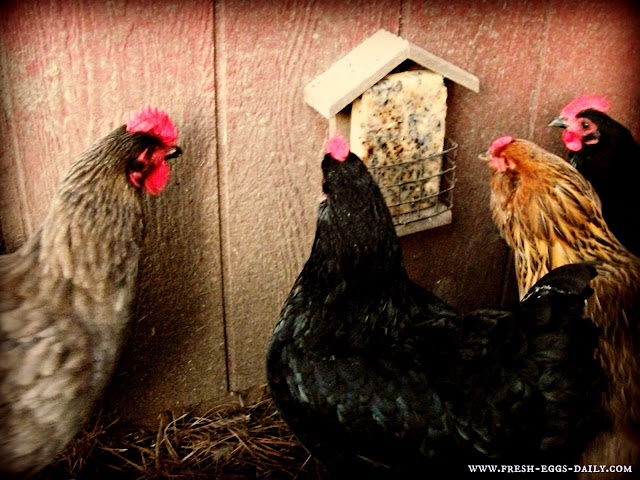
How about a Seed and Nut Wreath (pictured above)....
...or some Suet Cakes
Make a Flock Block Knockoff

Hang treats in baskets for your chickens.
Winter crops such as kale, collards, cabbage and other leafy greens are often on sale through the winter and make a nutritious, fun treat.


Subscribe to:
Posts (Atom)