Chick season 2022 is here! We begin with our first batch on Jan 27, 2022. Anice ChickenLady, has retired due to health issues. But Woodville Ace will be doing chicken business as usual. Join our Woodville Ace Chicken Group on Facebook, a link is in the left hand column.
On this blog you will find a list of hatch dates for birds ordered, CLICK ON "What's coming in?". To get your pre-paid special orders in call or come in to assure you get the birds you want.
By John W. Blehm – To say that Araucana, Easter Egg, and Ameraucana chickens are the same would be like saying Cornish, Brahma and Sex-Linked brown egg layers are the same. The chickens in the first group all possess the gene for blue shelled eggs and the birds in the second group produce brown shelled eggs. Having one or even several traits in common does not make two different breeds the same breed.
Araucana and Ameraucana chickens are completely different breeds just as Cornish and Brahma chickens are different. Each breed is different from all the others and the differences are listed in the American Poultry Association’s Standard of Perfection. We generally refer to it as the APA Standard and it tells what characteristics or traits are needed to classify a chicken under any of many different recognized breed descriptions. The Standard is the final word in the world of exhibition poultry in North America.
Our friends from Purina® wrote this free guide to help you enjoy farm fresh eggs for years. YES! I want this Free Report »
An Araucana chicken has ear tufts (not the same as muffs) and is rumpless, meaning it doesn’t have a tail. Ameraucana chickens have muffs and a tail. Both breeds have pea combs and lay blue eggs, but have just as many differences as similarities or common traits according to the Standard.
What is referred to as an Easter Egg chicken or Easter Egger is not a recognized breed, but rather a hybrid chicken that possesses the gene for blue eggs. These birds can be of any physical description. As far as “Americana” chickens go there is no such breed. It is just that many commercial hatcheries can’t spell “Ameraucana” and try to pawn off their mongrel chickens as such. When you see Araucana/Americana chicks for sale you can bet they are really Easter Eggers. Generally speaking, these are fine chickens for the backyard but would be disqualified at an APA sanctioned poultry show. Many novice poultry fanciers have fallen for the false advertising of these hatcheries and been very disappointed. Some hatcheries now have disclaimers saying their Araucana/Americana chickens are not for exhibition yet they continue to advertise them using APA breed names.
Araucana and Ameraucana chickens are both relatively new chicken breeds. The APA accepted Araucanas as a breed in 1976 and Ameraucana chickens in 1984. Before Araucanas were accepted and became a standard breed the term Araucana was used interchangeably with Easter Egger to describe all chickens that possessed the blue egg gene. Today some people still mistakenly get it wrong and that is partly due to all the misinformation and outdated information on the Internet and elsewhere.
A Bantam Ameraucana Black pullet. Photo by Michael Muenks, Missouri.
Myth Busting About Ameraucana Chickens
While on the subject of misinformation let’s try some myth busting. For many decades some commercial hatcheries promoted “egg facts” about “Araucana” eggs as being lower in cholesterol and higher in nutritional value than other chicken eggs. Even though those claims were proven false over 27 years ago many people still believe them to be true. Remember that Araucana, back in the day, meant any chicken with the blue egg gene. Heck, those same commercial hatcheries even claimed that “Araucana” meat had a taste similar to quail! Imagine that-chicken that doesn’t taste like chicken.
An attractive basket of blue eggs from large fowl Ameraucana wheaten hens. Photo by Barbara Campbell, Tennessee.
Oh, and how about those pink, green, olive drab and gold colored eggs that the catalogs advertised? The reason the egg colors vary so much is that the birds are of mixed parentage. There are only two true eggshell colors, blue and white. The gene that makes blue egg shells is dominant over the gene for white eggs. Brown eggs are really white eggs with a brown tint or coating. Green eggs are really blue eggs with a brown tint or coating. Just as there are many shades of brown eggs there are many shades of green eggs. You can tell if an egg is truly white or blue when the inside eggshell color matches the outside. Blue chicken eggs are not a robin’s egg blue color. They are a light pastel blue. Getting that good true blue color is still a problem that dedicated Ameraucana breeders are trying to get right especially in some of the large fowl varieties.
Large fowl Silver Ameraucana chicks
Which came first the Araucana or the Ameraucana? Actually, since both are now legitimate names of official APA breeds, let’s say the Easter Eggers came first. They came to this country as mongrel chickens and were bred to other types of chickens. Over the past several decades some breeders bred them to look the way they wanted. Some bred for tufted and rumpless characteristics, some bred for muffs and tails and others bred for whatever they wanted. Araucanas were not developed from Ameraucanas and Ameraucanas were not developed from Araucanas. They were both bred up from Easter Eggers or mixed breed chickens.
The tufted and rumpless breed was officially accepted first into the Standard. They took the name Araucana. There was still a large following breeding the muffed and tailed blue egg layers, so they had to come up with a new name for their breed that they had also referred to as Araucana up to that time. They organized a breed club and chose the name Ameraucana over American Araucana by a 9 to 5 vote.
Bantam Ameraucanas and large fowl Ameraucanas actually add up to two standard breeds of Ameraucana chickens. The big difference between the two is size. Bantams are just miniature versions of large fowl chickens or maybe large fowl are big versions of bantams. Either way the APA recognizes the same eight varieties in each breed. They are: black, blue, blue wheaten, brown red, buff, silver, wheaten, and white. Some breeders are working on new varieties such as lavender and black gold.
Few changes this year appeared when our first order came in one day early!
NEW! Our COMMON chicks that are listed on the blog (left column) are NOW $3.50.
We have not yet ordered our rare birds, but due to price increase from the hatchery they will also reflect a price change TBA.
NEW! Mount Healthy has changed their Easter Egger breed (lay colored eggs) from Auracanas to Americanas. Slight difference in breeding but they look much the same.
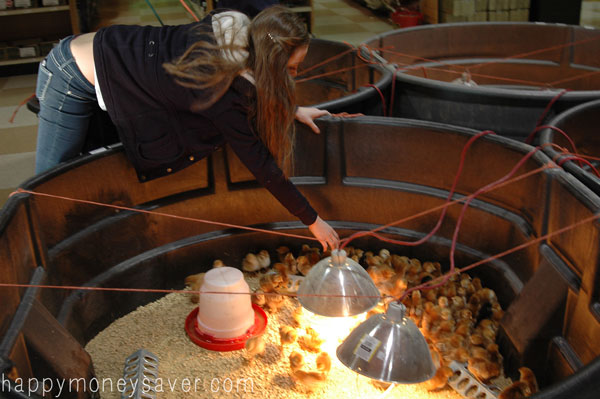
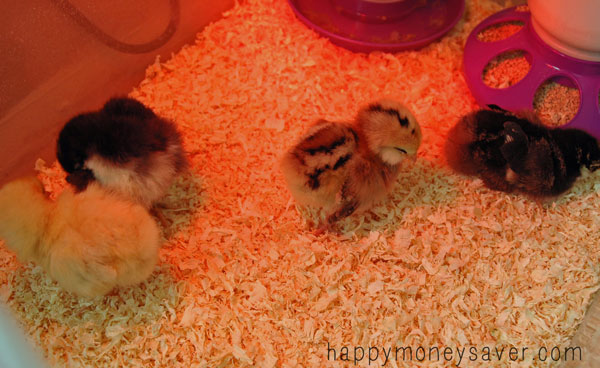
Raising chicks is infinitely easier than incubating eggs, but there is still much more to it than just plopping them in a coop. They need a toasty-warm mini-coop – a brooder – to nurture them into toddlerhood. If they had a mother of their own, the chicks would crowd under her feathers at night for warmth, and she would show them how to forage and keep them safe by pecking viciously at any predator that came lurking. There are many ways to build a brooder, but they all have to fulfill the basic needs of an orphan chick for the first six weeks of its life: food, water, warmth and protection.
Step 1 – Build a Container
Build is a relative term here. Many people raise chicks in a cardboard box. Play pens, kiddie pools, rabbit hutches, aquariums, plastic totes and other items likely to be found in a garage, barn or basement will suffice. You can build a custom chick mansion with private bedrooms for each one if you want, but the general rule of thumb is to provide at least one square foot of space per chick. For the first few weeks a small fraction of that space is fine, so one option is to start small and add on later.
The container needs to be at least 12 inches tall for chicks in weeks one to three, but by the time they are six weeks old the walls should be 24 inches high to keep them from hopping out. Or, you can add a lid. A lid is a necessity if there are pets or other creatures that may pose a threat to your baby chicks. Chicks need fresh air, however, so the lid needs to be completely breathable – hardware cloth or window screen stapled to a wooden frame is an easy way to go.
The brooder needs to be out of the elements so the chicks are warm, dry and safe from nighttime predators. A barn, garage or your living room are all fine options. You can also place the brooder inside the chicks’ future home – the coop.
Step 2 – Outfit the Brooder
Pine shavings are the bedding of choice for baby chicks. The essential oils in cedar shavings can cause respiratory distress and newspaper is hard for them to walk on when they’re little.
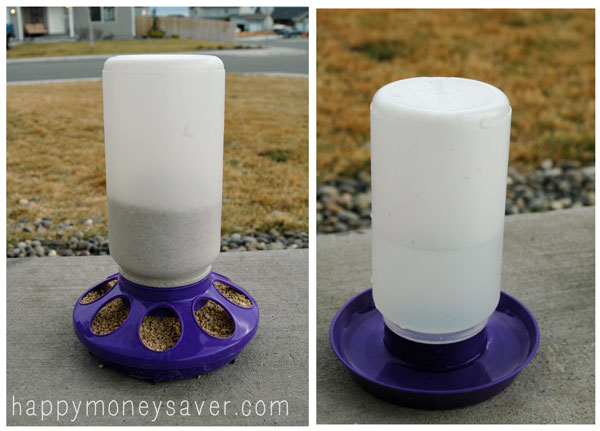
Spread an inch or two of shavings on the floor of the brooder and set up a watering and feeding station at one end. There are various DIY options for chick waterers and feeders, but the basic models only cost a few bucks at the feed store. Nipple-style waterers are highly recommended because the chicks can’t foul them with feces – good hygiene is critical to keeping chicks healthy.
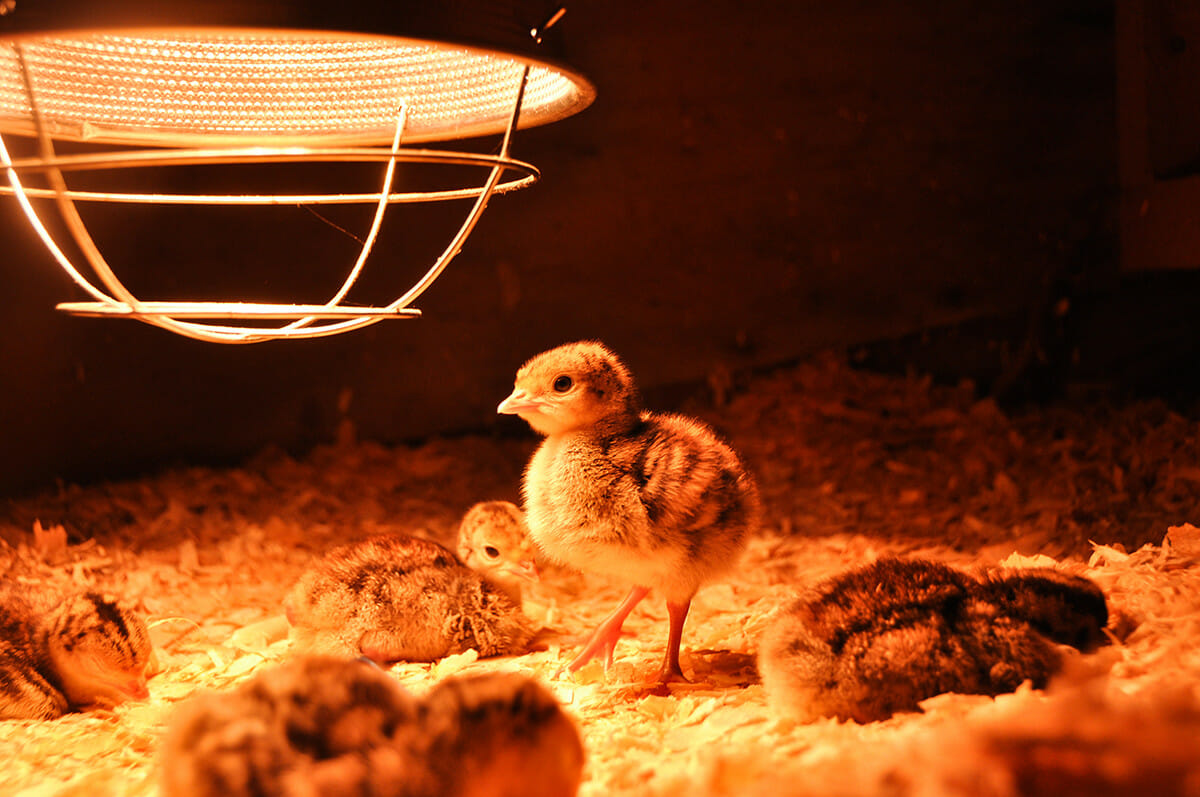
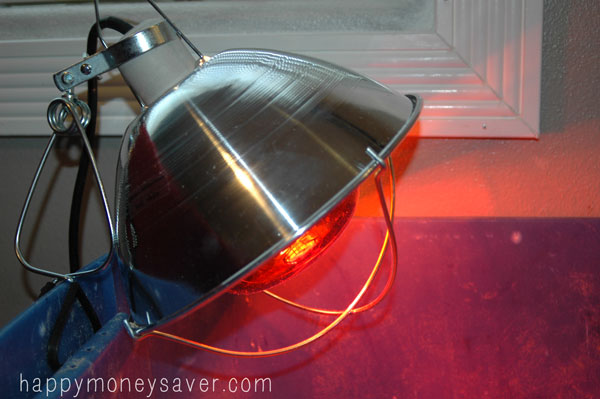
On the other end of the brooder, set up a heat lamp. If you have your chicks in the living room where it’s 65 degrees at night, a 100-watt incandescent bulb in a clamp-on utility light (the kind with a metal reflector) will provide enough warmth. If they’re in a barn, garage or another location that gets chilly, a heat lamp is in order. These special bulbs can be found at feed stores or ordered online.
The height of the bulb may need to be adjusted anywhere from 12 to 36 inches above the bottom of the brooder to maintain the optimal temperature for the chicks. One easy way to accomplish this is to hang the light fixture by a chain attached to a hook above the brooder.
If hot bulbs in close proximity to a cardboard box filled with wood shavings and baby chicks makes you nervous (it definitely qualifies as a fire hazard), consider an EcoGlow brooder heater, which are also designed to save energy.
Step 3 – Care for Your Chicks
Chicks need to be at a constant temperature of around 95 degrees for the first week of their life. Mail-order chicks are almost always less than 48 hours old; if you get your chicks at a feed store, ask how old they are before bringing them home. Adjust the height of the bulb and use a thermometer to measure the temperature at the bottom of the brooder to get it into the proper range before the chicks arrive.
Dip the beak of each chick into the water source as you put it in the brooder so it knows where to go when it’s thirsty.
The chicks will tell you if they are too hot or too cold: if they are huddled on top of each other directly under the bulb, move the bulb closer to warm them up; if they are pushing against the opposite wall of the brooder away from the bulb, it’s way too hot. Chicks milling about throughout the brooder is a good sign that the temperature is just right.
Lower the temperature of the brooder by about 5 degrees each week. As the chicks’ feathers fill in, they are more tolerant of cold, but they are also prone to overheating, so it’s important to keep the temperature just right.
Food and water should be available at all times. Chicks need a special ‘starter feed‘ during their time in the brooder. Starter feed has a crumbly texture, but gets clumpy when moist. If this occurs, clean out the feed tray and add fresh food to avoid mold developing.
It’s a good idea to clean out the food tray every few days anyway because the chicks can’t reach every bit and it will start to get stale. Waterers should be cleaned out daily (unless you’re using nipple waterers, which don’t require cleaning), and the bedding should be refreshed every other day by scooping out the top layer and adding shavings.
Once the chicks are six weeks old, their feathers should be filled out and they are capable of tolerating cool nighttime temperatures – so it’s time to transfer them to the coop. To smooth the transition, move the heat source, feeder and waterer into the coop for the first few days, and set up an adult-size feeder and waterer.
Chicks Basic needs: brooder (containment) Light (heat), feeder, waterer, chick food, and bedding. Your chicks will live inside, in this brooder up 10 weeks depending on the weather.
Here at Woodville Ace we will help you set up your brooders and get what you need. We also sell full size chicken coops and DIY supplies for the next step.
Come see us, Anice
I am so delighted to share all the information I have learned on how to raise baby chicks. Whether you are dreaming of fresh eggs, learning to be more self-reliant, looking for a great pet or wanting your own home-grown chickens for meat, just about anyone can raise chickens.
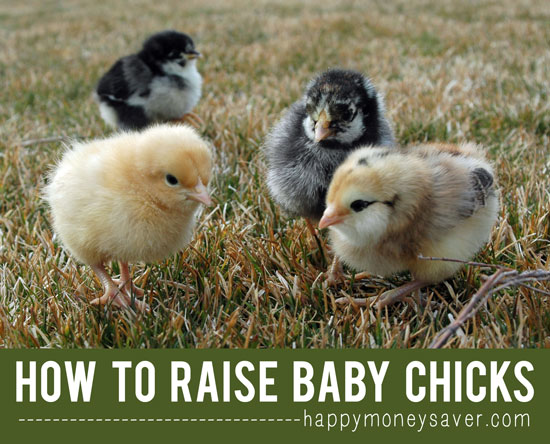
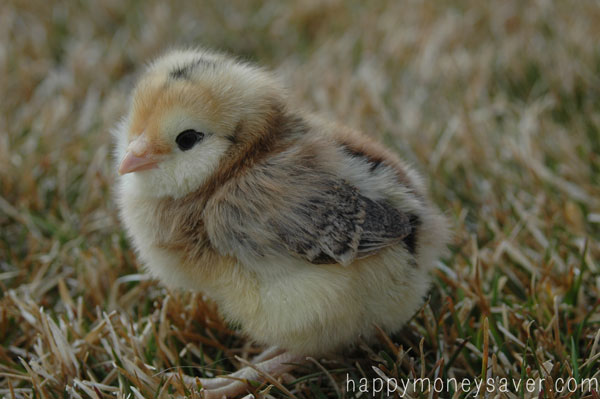
I love my chickens. But growing up I was terrified of them. The drive for learning how to be self-reliant and the desire for fresh eggs helped me to overcome my fears. I live in the city and only am allowed a couple of chickens, so I brought home 4 chirping little baby chicks this past spring. After learning how to raise baby chicks and watching them grow, I can say they are the most enjoyable pets I have ever raised. They are super easy to care for, can be very loving, inexpensive to feed plus you get super delicious fresh eggs from them too.
How To Raise Baby Chicks
You will need a few supplies and items to care for baby chicks. Here are the supplies you need.
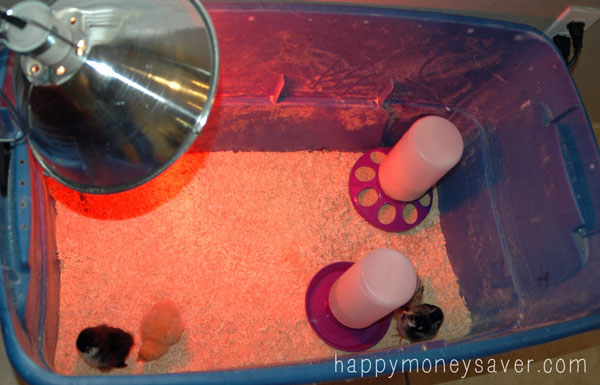
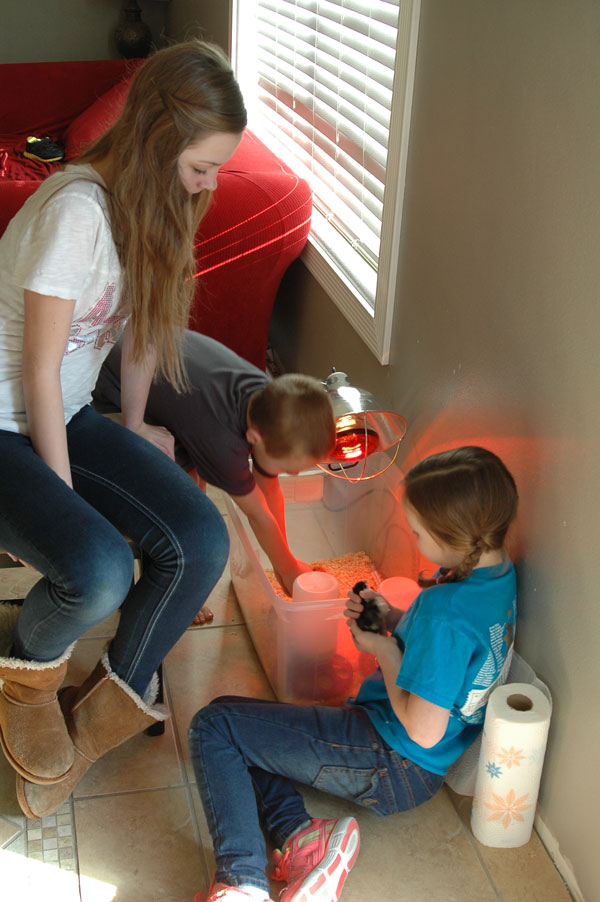
A brooder box or bin to keep them in. You can use a stock tank, swimming pool, your bathtub or even an old kids swimming pool. I used a plastic tote for my chicks since I already had them hanging around my garage. Some people use a cardboard box as well, but I don’t recommend it.
A Heat Lamp + Heat Bulb. When you buy your heat bulb try to get the red light heat bulb. Chickens will peck each other to death if they see blood, so the red light will make everything red thus avoiding any pecking injuries. You could also use a white heat lamp as well and just keep a good eye out for them. Consider also keeping a backup heat lamp just in case one burns out. A Thermometer – You will be using a heat lamp with a reflector, which you can find usually at the feed stores or even hardware stores. The temperature needs to be around 90 degrees for the first week, then can be reduced by 5 degrees each week until the chicks have their feathers in (usually around 6-8 weeks). Watch your chicks carefully though as they will show you if they are too hot or cold. If they are huddling in the corner farthest away from the light they are too hot, and if they are huddled in a ball under the light they are too cold. Just keep an eye on how they are reacting. Use the thermometer to get your heat lamp at the right height for the temperature needed. You can find these at your local Walmart or any hardware store for around $1.00. Some sort of bedding.Pine shavings are what I use, but you can also use pine pellets, straw or other soft materials. Avoid cedar shavings and newspaper shreds as they are not great for chicks. Baby chicks do poop a lot so be prepared to be changing this often. Feed – get chick starter feed from feed supply stores. This is all your chicks will need to eat. If you want to start giving them treats or bugs, wait until they are one to two weeks old first, and start some chick grit at the same time. I think the first thing I treated my chicks to when they turned a week old was a single shred of cheese, they loved it.
A Waterer and a Feeder – I used these little plastic ones you can find at feed stores for a couple of bucks each. Make sure and change out their water every day as they often poop and kick shavings in them. Netting or chicken wire to put above your brooder box. Little chicks will fly up within a few days usually to get out, so put netting over the top to keep them from escaping. You can use a little piece of chicken wire or fine hardware mesh that covers it. The big Chicken Coop they will be using when they are older. It’s best to get this figured out early so they are not giant chickens in a little bin while you are trying quickly & frantically to build a coop for them.
Where to get baby chicks
I called the feed store in my town to see when they have their “chick days.” Turns out most feed stores have a day where they will get in a huge lot of baby chicks where you can choose to pick up just a few or a large lot of chicks. Some even offer free deals where if you buy the feed you will be able to get a free chick. Make sure when you call you ask what breeds of chicks they will be getting in. Do some research on the kind of chickens you want to raise – whether for meat or for laying, fancy or bantam, temperments and more.
I had my kids go online and google pictures of which breed of chicken they would like to raise. They chose by color pretty much. We went down to our local feed store on “chick day” where they each brought home the kind of chick they wanted. Going the feed store was perfect for us since we are only able to have a small amount of chicks and we were able to get a variety of chicks. It was so much fun and the kids had a blast (read about it here).
Caring for your baby chicks at Home
Whether you just came back from the post office or the feed store with your new baby chicks in hand, make sure all you have their nice little brooding box all ready to go. Make sure you have read all about how to raise baby chicks so you are prepared.
The first thing you need to do is dip their little beaks into their waterer for a second so they knew where the water is.
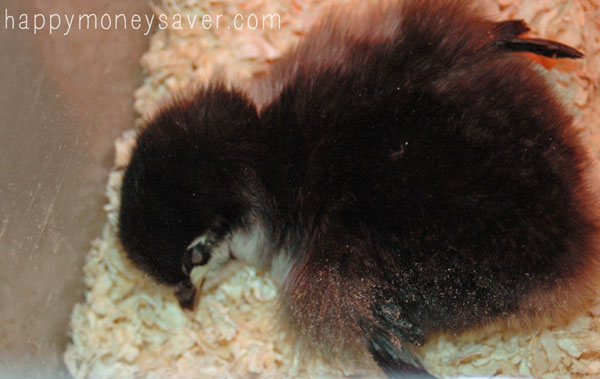
Then they will chirp around, eat their feed, poop and sleep. They will just be running one minute and then drop like they are dead the next.
The drop-dead-look is normal, it’s just how they sleep. They are so adorable.
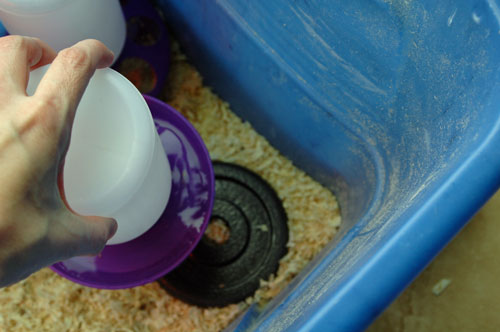
If you find your chicks are constantly kicking their pine shavings into your waterer, add a book covered in a ziplock bag or a weight underneath. It helps a little. But still check the waterer often for poop and shavings. Wash it in soap & water periodically also to keep them healthy.
Chicken Poop & Pasty Butt
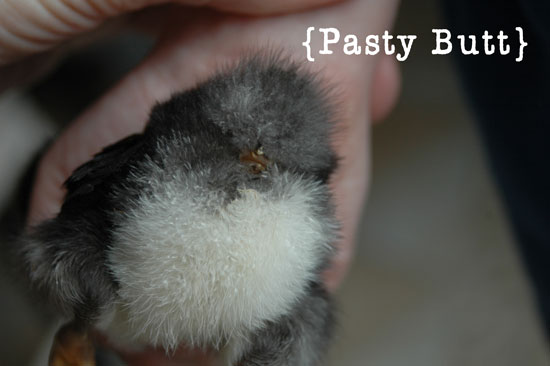
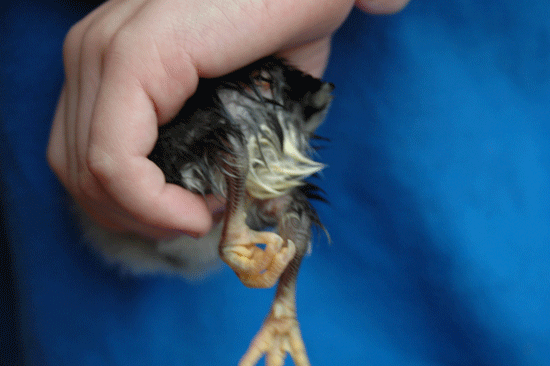
Keep an eye out for a condition called Pasty Butt with baby chicks during the first week. If the chicks get their poop stuck to their bums, it can seal it up and will kill them if they can’t go. So if you start seeing any poop stuck you gotta wash it off. Only one of our 4 chicks had this. Sorry if you are grossed out by this, but farming ain’t all flowers and fresh milk.
Oh yeah, I am making you look at a chicken’s butt. Tee hee..
So when your chick gets Pasty Butt you just need to take a warm wash cloth and wash the poop off gently. No picking it off, it can hurt them. We had our baby chick sit in some warm water (in a bowl) and gently washed it off.
Problem is when they have wet feathers, the others will peck at them so you will want to separate them until dry. My son held our chick with a wash cloth until she was dry. He loves doing things like that.
How often do you change their pine shavings? It all depends on your preference. I had my chicks in the house and once I could smell it I would be changing it. This was usually every 3-4 days. During the first two weeks it seemed like their poop was out of control, but as they got older their poop changed to a different consistency and I was able to change it once a week.
THE COST
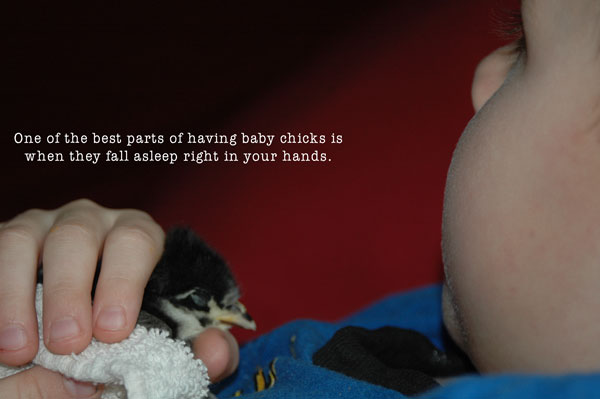
I spent around $50-$60 for all the supplies I needed for my baby chicks including feed and bedding for 2 months. But the real expense can come with the big chicken coop you need to buy or build. If you are super thrifty you can use scrap wood, pallets or other materials and create for a really low cost. I will update this post after my chickens are a year old so we can really see how much it costs to raise them. We have LOVED having baby chicks. They are very entertaining. Just for fun try scratching your finger to the bottom of the pine shavings bin and see if they copy you (its so cute seeing them learn to scratch for the first time.) After a few weeks we offered them a few treats (you can buy freeze dried worms and they go nuts…). But our favorite thing is when they just fall asleep in our hands, it is the sweetest thing ever.
Get your brooders ready! Time to start planning for your new flock. Dreaming of a summer with beautiful chickens running around your yard and lots of eggs?
Our first chicks have been ordered and soon the big brooder will be in the center isle of our store.
Check the column to the left of this blog for Hatch Dates. Chicks arrive one day after Hatch Date, normally arriving every Thursday, depending on weather.
WE ARE NOW TAKING PRE-PAID SPECIAL ORDERS! CALL 850-421-9000 TO PLACE YOUR ORDER OR COME INTO THE STORE.
Please read our policy and procedures for how we do chicken business here
at Woodville Ace Hardware.
Our main hatchery is Mount Healthy. We have used them for several years and have a wonderful working relationship with their team.
I am excited to share this video (below) featuring Mount Healthy.
Stay posted on this blog for more information on how to get started with your chicks and what they need, chicks that fit your wants and need and more.
It remains inconclusive how backyard chicken farming went from an obscure hobby to a mainstream passion that is driving people towards having their own backyard farms even in urban setups.
Oh yes, it is not uncommon to hear the rooster crowing in the middle of the city these days, thanks to these dainty little chicken colonies.
Some call it the demand for locavore food while others pin it to the rising need and awareness about the potential hazards of industrial farming. Irrespective of the motivation, backyard farms are thriving.
Chances are that the succulent free-range and organic chicken leg that you picked up the other day was bred a few meters away from your home.
Each day, I receive numerous emails from want-to-be farmers enquiring about the essentials needed to get started with their own farms.
Well, the most important part of the equation is a chicken coop. A sanitary and spacious retreat for your chickens to retire to, at the end of the day, with a possible place to perch and nest safely. And the sky is the limit here. You have everything from barebones models to high-end swanky coops that can put an upmarket dog kennel to shame.
But you don’t necessarily need a bank-breaking model for your farming needs. If this is the first time you are venturing into chicken coop shopping, then here’s a small guide that will help you get started with your purchase.
Everything said and done, here’s my pick of the best chicken coops for sale in the market currently. I have been growing chicken for years now and I have dealt with my share of gimcracks. These coops have been picked after careful analysis of their space, features, ease of access, maintenance, and their customer ratings. Every product on this list has a minimum of 85% positive customer reviews.
Table of Contents
Best Rated Chicken Coops 2019
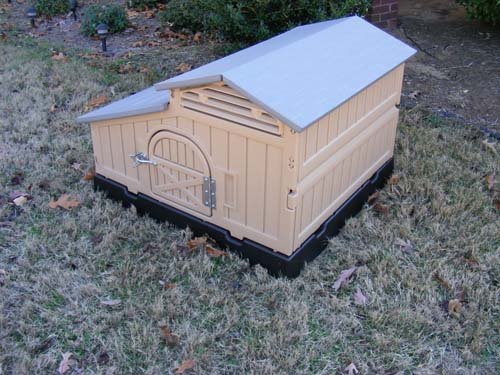
1. Formex Snap Lock Backyard Hen House
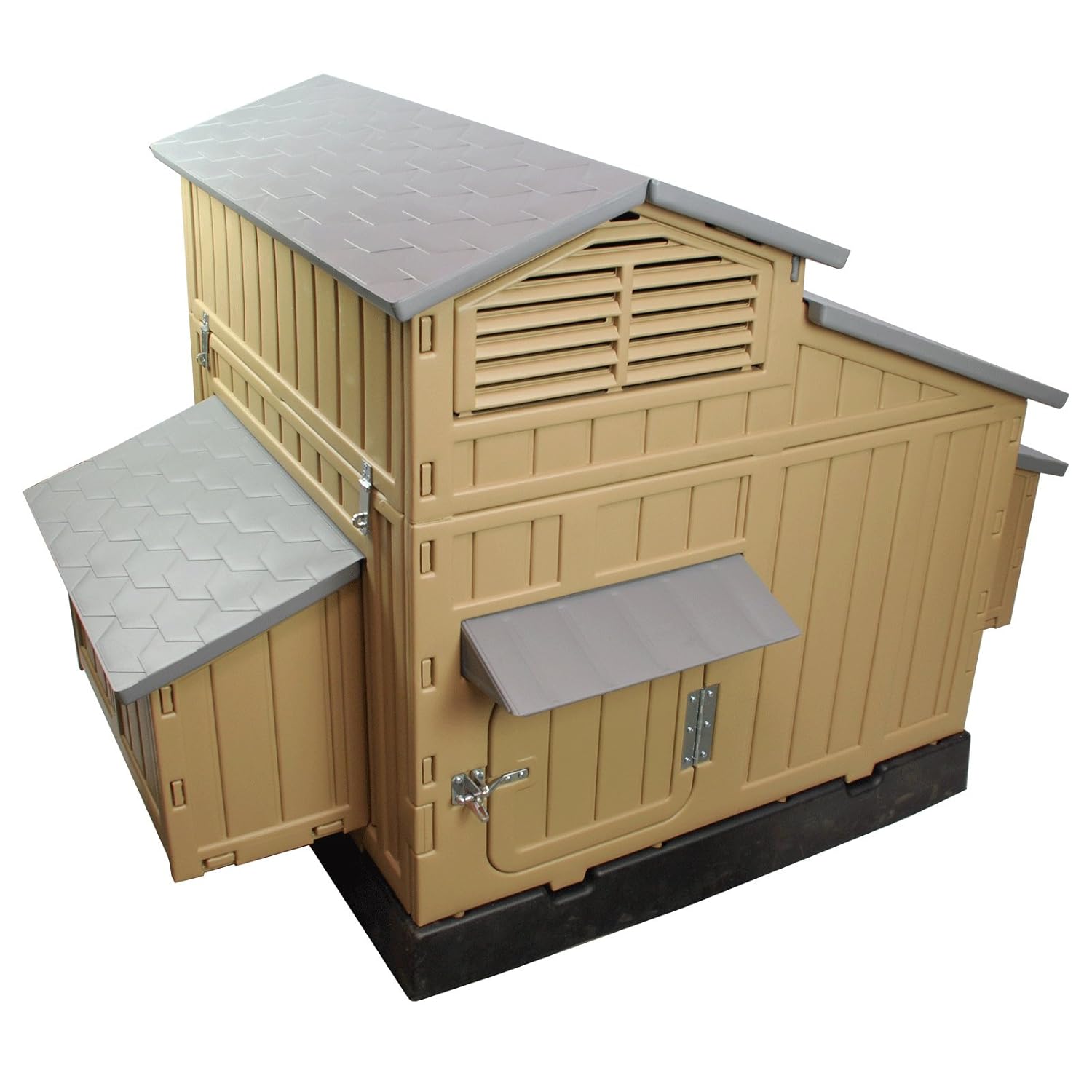
Nobody said that a chicken coop had to look mundane. This Snap Lock backyard hen house from Formex is a beautifully designed one. So much so, that you may just be tempted to keep this inside the house. It is shaped like a dog-house and features a dual tone exterior in subtle but attractive colors.
But the reason why it features on the top of our list of best chicken coop design goes beyond its stunning good looks.
Lightweight and weather resistant
Out of the box, the Formex Snap Lock backyard hen house stays true to the name. It can be just snapped-on together in minutes and you will not need to fiddle for hours with tools to get it set up.
You will be surprised at how light the coop is. It is made of blow-molded plastic and it weighs just under 40 pounds. So, even if you need to move the entire coop to a different part of the backyard, you can do it without seeking assistance from another person.
Despite the lightweight profile, the coop is as durable as they come. The plastic does not crack or peel and is perfect for all kinds of weather conditions thanks to the insulating double walled construction.
Lay some straw in it for the winters and it stays warm. On sweltering summer days, let the ventilation do the job. By the way, the ventilation is completely adjustable too.
Secure and Easy to use
The product is 100% predator safe without compromising on the ventilation. It has lockable access which will ensure that your chickens stay safe at all times. At the same time, it is designed for easy access. The hinged roof gives you access to the nesting boxes without disturbing the hen.
Also, there is a removable litter tray that catches the droppings, feathers, and dirt making the coop extremely easy to clean.
The coop is available in two different sizes. The smaller sized one is spacious enough to house 3-4 Large chicken and the large sized one can be used to house up to 12 standard sized hen. Verdict: Formex Snap Lock backyard hen house is manufactured in the USA and has been used by chicken farmers in a variety of weather conditions. It is extremely durable, low on maintenance and roomy enough for a backyard farm.
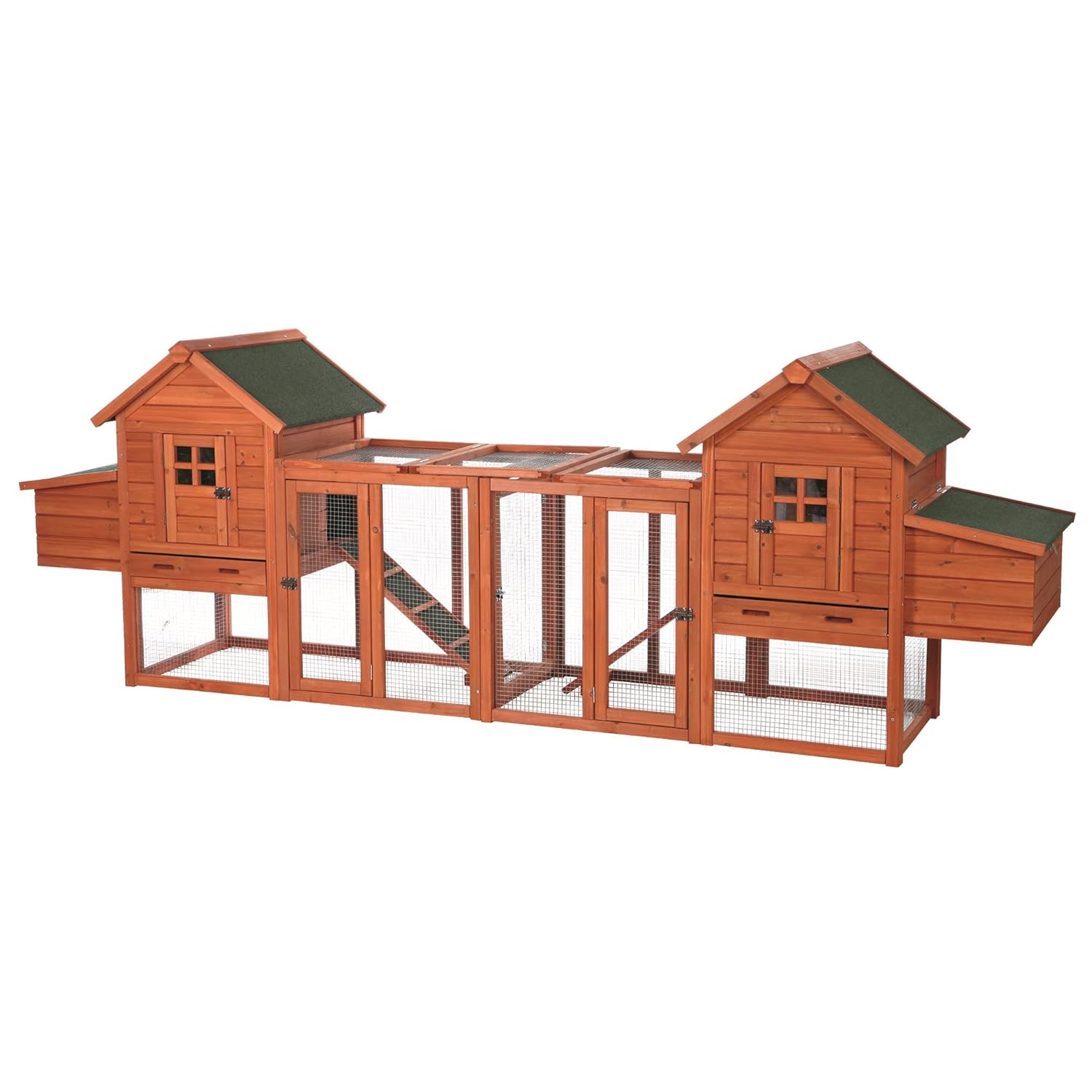
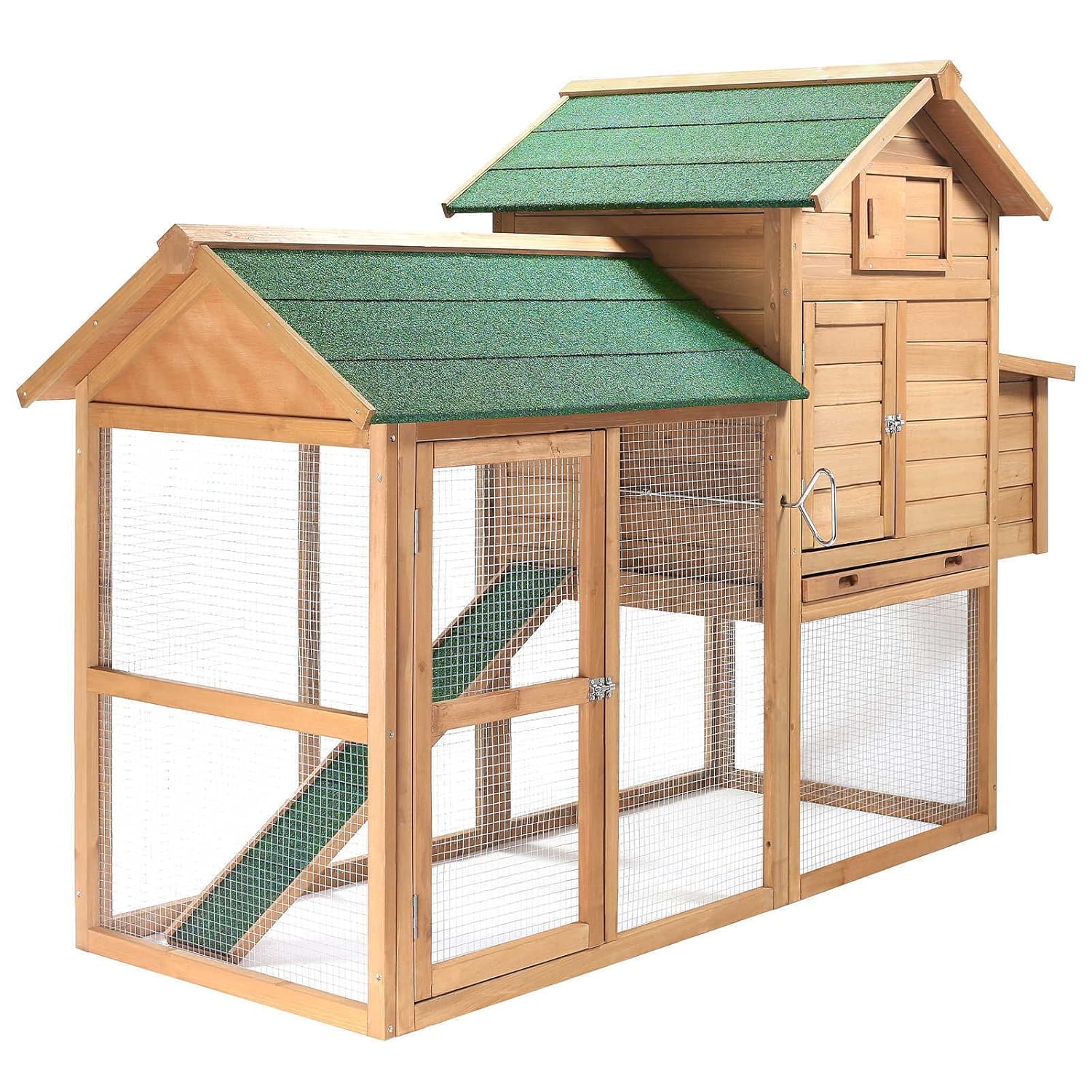
2. TRIXIE Pet Products Chicken Coop Duplex with Outdoor Run
If you are looking to start with a bigger flock, then you must take a look at the Duplex Chicken Coop from Trixie Pet Products. Like our number one pick, this one will grab eyeballs too. Let’s say I am a sucker for beautiful designs. But hey, I am sure nobody likes a product that looks like an eyesore in your backyard.
This chicken coop is everything you need to raise a flock. It comes with an outdoor run, roosting poles, ramps and nesting boxes. Club this with a predator-proof design and you have a winner on your hands.
Roomy design
Once you are done getting awed at the beautiful pine wooden finish and the green roof combination, you’d appreciate the roomy interiors that the coop has. The manufacturers advertise it as being the right size for 6 standard sized chickens. But it can easily accommodate up to 8. I am talking about the XL sized coop that is.
The positioning of the roosting poles and the nesting boxes is immaculate. The fact that the removable cleaning trays are placed right under it makes the coop extremely easy to clean and maintain too. Also, the ramp gives chickens easy access to the roosting poles.
Nesting houses feature hinged roofs for easy access to the eggs, removable dividers to prevent the eggs from getting broken by other hens and fixtures to secure the doors with padlocks. The padlock fixtures are not of the best quality though. If you are concerned about raccoons or weasels gaining entry after fiddling with the padlocks, you can easily replace them with better quality ones bought off Walmart. This is not a deal breaker when you compare the other features of the coop.
Easy access
Access to the interiors of the chicken coop is such an important part of growing healthy chickens. This product features both front and top doors which allow you to clean it easily from the inside.
The outdoor run will prevent the chicken from running haywire in your lawn and pecking it bare. Verdict: The Trixie Duplex chicken coop is an ingeniously designed package. It will keep your chickens happy and will make life easier for the first time chicken farmer. You can pick from eight different size options too.
3. SmithBuilt 7 feet Wooden Two Storey Chicken Coop
SmithBuilt’s Two Storey Chicken Coop is the stuff chicken dreams are made of. As evident by the name, this is a huge coop that runs 7 feet long and features multiple stories. The upper one houses the residential quarters while the run is downstairs. Chickens can switch between the two while you can stay rest assured that they are protected from predators and the like.
Solid Fir Construction
There is something about coops made from solid wood which makes them more appealing and also durable. This one is made from Solid Fir that has been coated for the outdoors. If there is much rain in your area, then I’d recommend that you treat it with an additional coat just to be sure.
Despite the all-wood construction, two people can lift it off the ground to move it.
Assembly may take more than an hour and a half considering that the multiple storied design comes with a lot of screws.
Easy access and cleaning
The SmithBuilt 7 ft. wooden coop features a roosting bar that can hold up to three chickens at a time and a nesting box on the side which can be separated by a divider. Access to the nesting box is via a hinged roof that lifts upwards. The nesting box and the main living quarters are surrounded by a wooden enclosure that keeps the coop warm even on cold winter nights.
The slanted asphalt shingles on the roof ensure that even the tiniest bit of rainwater doesn’t find its way into the coop.
One of the things that I’d like to mention here is that some people mistake it to be 7 feet tall. No sir. This product is 7 feet long. In other words, it runs that long with the run included. The actual living quarters for the chicken is 26.25 long and 32 inches high. That more than suffices for three chickens. But if you feel its too cramped, you can use it for two full-sized birds. Verdict: The SmithBuilt 7 feet chicken coop is one of the best chicken coop kit on the market. The solid wood construction and the intuitive design makes it a great choice for backyard farmers looking for a ready to use package.
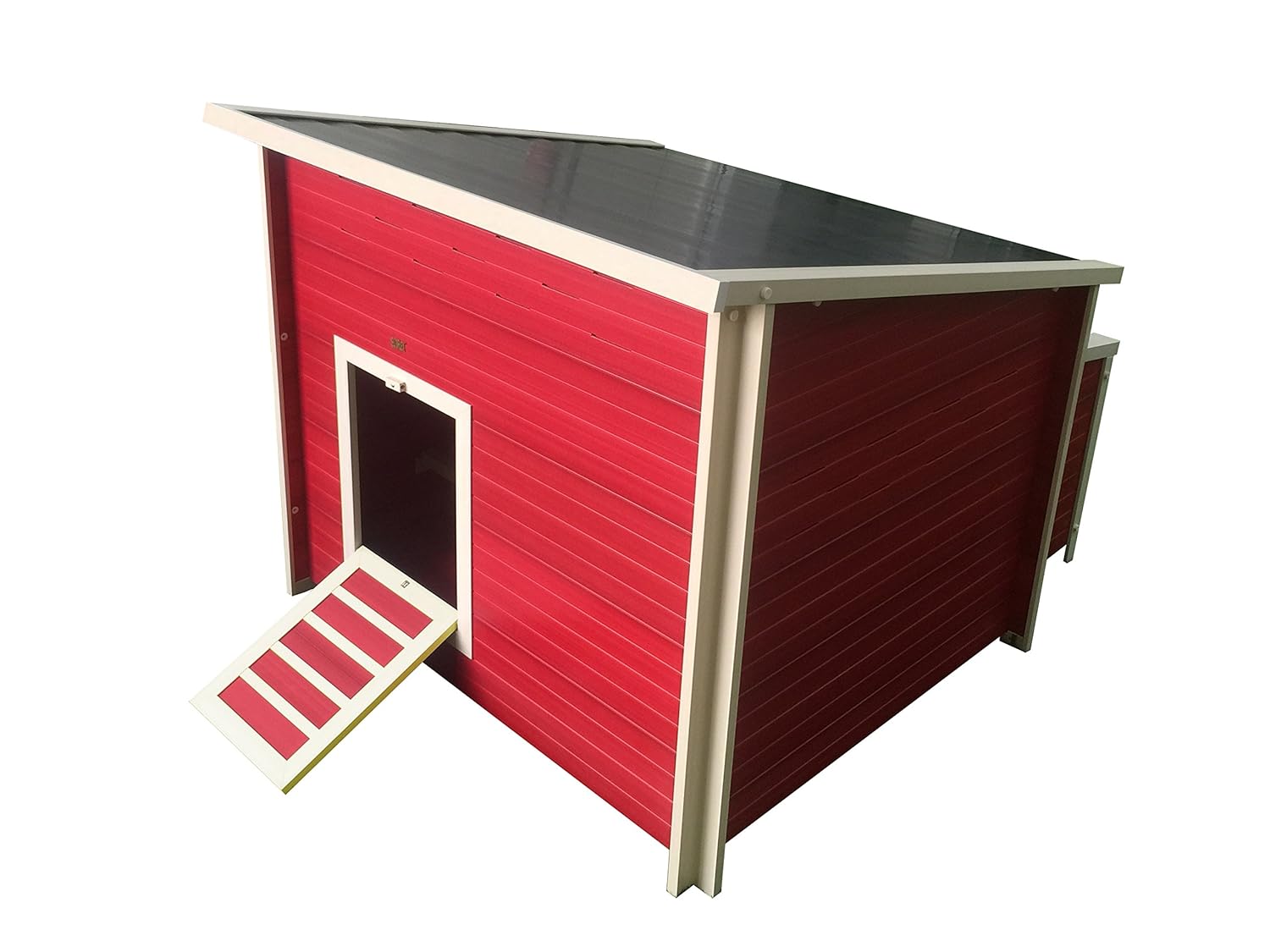
The Fontana Chicken Barn is a very popular chicken barn thanks to its spacious interiors and durable construction. It is made from Eco-Flex, which is a combination of recycled wood and polymers. The material is incredibly durable and resistant to even the harshest of weather conditions.
The Chicken Barn is designed for easy assembly and you should be set up in less than an hour.
Secure and spacious
The Jumbo sized Fontana Chicken farm gives your hens a whopping 12 square feet of moving space. Even if you adhere to the mandatory 1 sq feet per bird inside the coop, you can easily house up to 12 standard sized chickens at a time or up to 10 ducks if you plan to use it as a duck house instead.
The large interiors are perfectly complemented by two roosting bars and 3 nesting boxes which are divided by partitions.
The Eco Flex material is one of the best ones for use outside the home since it does not absorb moisture or get warped, cracked or peeled. Customers have used it for years without as much as a blemish to show for it.
Warm and cozy
If you live in an area with mild weather, then you need not worry too much about the temperature inside the coop. But if you live in an area with extremely hot weather or severely cold weather, then you’d be glad to know that the Fontana Chicken farm provides excellent insulation during winters and has multiple ventilation slats for the summers. During the rains, this prevents condensation from setting inside and your chicken will stay dry.
And if you want to use a heater for the winters, the roomy interiors ensure that you can position it without hindering the movement of the chicken.
Access to the interiors can be via the hinged lid for the nesting boxes or via the removable roof (it can be removed in minutes). Verdict: The New Age Fontana Jumbo chicken barn is a steal. It lets you accommodate up to 12 chickens and is designed to last for years without any damage to the exterior. Highly recommended!
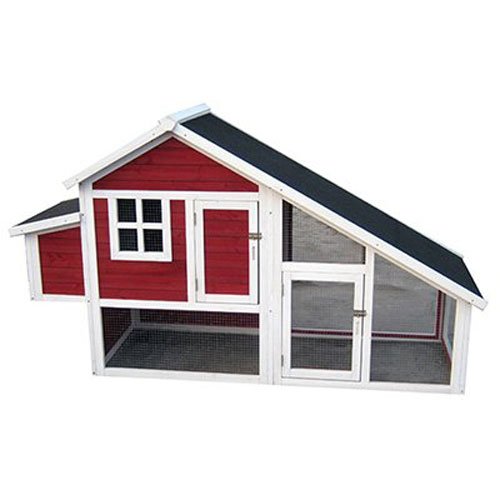
If you are looking for a coop and a chicken run combo that is perfect for about three hens, then the Merry Pet Habitat Coop should be a great choice for you. It is used by a lot of people in urbane setups due to its compact footprint and all-inclusive design which eliminates the hassles of buying and setting up a separate run.
Also, it is secure and looks beautiful with red satin panels and a black roof.
Easy to assemble
The Habitat coop for chickens is made from fir. I am not sure whether it is Douglas-fir, but it certainly looks like it. The wood is durable and does not warp or peel after moisture and sun exposure. Despite the many parts included in the package, assembly is fairly simple. The package also includes a few extra sets of screws just to ensure that you don’t misplace anything. It should be completely set up in a couple of hours.
Access to the coop is relatively simple. A hinged roof lets you access the internal part of the coop and a slide out pan collects the droppings and feathers keeping the main coop clean and dry.
Ventilation is excellent thanks to the multiple netted windows which provide ample air and light into the coop. This will keep the raccoons away pretty easily.
The main access door has a latch. If you are paranoid about predators, then you can replace it with a sturdier padlock.
Roosting pole and nesting boxes
The Merry Pet habitat coop for chickens also includes a roosting pole that is sufficient for two chickens and a large nesting box which can be separated by a divider into two boxes.
The main area is connected to the run via a ramp which has horizontal slats for better traction as the chicken enters the coop. The metal wire on the run is durable and does not rust even with rain exposure. The openings are quite small and will keep snakes from entering the coop. Verdict: With an in-built chicken run, the Merry Pet Habitat coop for chickens brings unbeatable value to the table. It is durable and can hold up to 4 hens at a time. Great buy if you are looking for an all-inclusive choice.
The chicken coop you buy will be a very important investment in your crusade as a poultry farmer. If you are an experienced farmer, then it goes without saying that you’d be aware of the essentials. But if you are new to it, then here are a few details that you need to be aware of.
How many hens do you plan to keep?
First and foremost, you need to decide how many chickens you plan to keep. If you plan to keep chickens to get eggs for the family, then three to four chickens can give you as many as 700 eggs a year. That’s specific to some breeds though. Rhode Island Red, for example, lays as many as 250 eggs a year per chicken. There are other breeds which lay much lesser. Also, as the hen ages, she will continue to lay fewer eggs each passing year. She will eventually stop laying when she molts. The number of hens you plan to keep will determine how large a coop you need. You should also take into consideration the amount of space in your yard that you plan to allocate to the coop.
Are you aware of the town ordinances?
You also need to be aware of any restrictions that your town may have regarding keeping chickens. Some towns disallow roosters because of obvious reasons. Others have a limit on the size of the flock, the size of the coop and the location of the coop. Ensure that you are updated on these.
What do the chickens need?
Protection
There is a common misconception that chicken living in a backyard farm do not need protection from predators. Oh, you couldn’t be more mistaken. While coyotes may seem like a far-fetched proposition, there is a very real threat from raccoons and dogs. Also, hawks and owls will snag a chicken if given a chance. The coop needs to be secure and safe preventing these predators from gaining access to them in any way. Windows need to be covered as well.
Other than this, they need to be protected from the vagaries of weather.
Food and water
You will need a waterer and an automatic feeder if you do not want to spend time manually spreading scratch. These additional tools will save you time and effort. But also consider the possibility that storing these in the coop may make it more cramped for space. People living in cooler climates may need to invest in a water heater.
Space
It is estimated that a laying chicken needs at least 1.5 square feet of space inside a coop and approximately 8 feet outside of it on the run. You may be tempted to cram as many as possible into a small coop. It will only lead to distress among the birds and they may start to injure each other. Also, more the room to move about, the happier the chicken.
Desirable Features
Now that you are aware of the essentials of starting your own backyard farm, here are a few features of a good quality coop.
Easy to clean
Chickens are messy. The coop will be covered in bird droppings, feathers, and dirt that is tracked inside. It is in your best interest to keep the coop clean. So, look for a coop that lets you access the insides easily. Most coops have multiple access points including a removable roof and a large door. You must also be able to remove the nesting boxes and the perches so that you can hose down the place from time to time.
Egg collection
Look for one that lets you access the nesting boxes from outside. This will allow you to collect the eggs everyday without opening the coop and disturbing the flock.
Airy
There has to be a minimum of two points of ventilation in a coop. Most coops have it positioned near the roof. This prevents a direct draught from blowing into their feathers which they absolutely despise. Lack of proper ventilation can cause a whole range of problems for your chicken. So consider this a very important feature.
Nesting boxes
The nesting box is one of the most important features of the coop. Your chicken will lay at least an egg each day of the year except for winters. And they need a cool and dark place that is not disturbed frequently. It needs to be lower than the perches and give them easy access at any time. This will ensure that the eggs stay safe and the nest box remains clean. As I mentioned earlier, the nest box also needs to have external access to remove the eggs.
Material
There is nothing better than a good quality wooden coop. But the market is flooded with cheap Chinese wooden coops that will warp and crack in a few months. Ensure that you check the type of the timber and the thickness of the coop. It needs to be weather resistant too. The other options are molded plastic which is easier to clean and does not fade or chip with time.
The Run
Last but not the least; the run is an important part and most coops will have a run built in. If your coop doesn’t have one, you can always order it separately. A chicken run gives the chicken ample space to move about keeping them safe from predators and it also lets you round them easily at the end of the day.