Search This Blog

Monday, September 24, 2018

Pecking Order and Feather Picking

Feather Pecking amongst Chickens

Identifying Feather Pecking


Last week I was working in my chicken run and took out their toys to clean and fill in some holes. A few days later I came home to my beautiful Cuckoo Maran all bloody and pecked up. I quickly treated her and put their toys back in and added a few others. Within a few days everything was back to normal and no more pecking. It can be something as simple as moving things around or adding items that chickens like to play with. I used some old flower pots on a bamboo stick, blocks of wood or hang a ball in the run. It doesn't take much but with a little imagination you can give them something to keep them  from turning on each other. When I talk to customers about chickens, I use the example of kids on a playground, "Some days they all play nice together and next thing you know they are duking it out." I learned my lesson! Anice


To some people chickens are just those brown feathered things that lay the eggs you keep in the fridge. To others (the special, initiated, fans of chickens) they are a constant source of enjoyment and as much a member of the family as any other pet.

However, whatever your view on chickens, they have become embedded in the very lexicon of our language. If you are in a small space you feel "cooped up". Perhaps your "chickens will be coming home to roost" because you have "chickened out" and are now "running around like a headless chicken".

Possibly the most pervading though has to be "the pecking order", from the Houses of Parliament to Poultry Houses there are pecking orders, however, only in the latter case does any literal pecking occur (well ... ...)


Identifying Feather Pecking

Chickens will always peck at each other a little bit, this is almost an essential part of establishing a "pecking order" or hierarchy amongst the flock. So the 'top hen' will peck at others and the lowest bird in the order will be pecked most.

Most of the time this isn't a real problem and you'll probably find that the bird at the bottom of the social order will merely high tail it away if it gets fed up and no real damage is done. However, if your hens are kept in an enclosed run, simply running away might not be an option.

Feather pecking is, as the name suggests, when one hen starts pecking at another's feathers and pulls them out causing distress to the birds and, in some cases, draws blood from a wound.

This is not to be confused with an over-amorous cockerel who can often pull feathers out of a hens back while trying to gain a perch, or even the annual moult. Feather pecking often occurs around the hen's vent, tail or head. A good indication that feather pecking is occurring is not only bald patches on the birds but the sign of half eaten feathers around the coop.

Chickens are attracted to the colour red (one reason why so many poultry feeders and drinkers are red) so the comb, wattle and the vent - which is often reddened after laying an egg - draws the attention of other hens. Chickens are also attracted to blood, the colour and smell (they are after all essentially mini dinosaurs) so, if wounds are left untreated, it will only attract them more. Always make sure you treat any blood or wounds straight away with either a gentian violet spray or a wound powder, for the well-being of the bird.

Boredom

Boredom


This is number one on the list. If your hens have to be kept in an enclosed space (for their safety and your sanity) then perhaps this is the easiest to solve. Convention says that a hen needs 3 sq. ft. of outdoor space when permanently enclosed in a run. You might find giving your birds that little extra bit of space, if possible, will solve the problem.

Equally, like all living things, chickens like to feel the sun on their backs (but they will still need shade options too). If you have them tucked away in a dark and dingy corner of the garden, can you move them so that they can enjoy more daylight? If neither of these are an option for you, giving the birds something to occupy themselves is one way to cure boredom.

Hanging Boredom Buster Chicken Treats or perhaps a few fresh greens hung around the run will help keep your hens distracted and busy. Do your hens have a nice friable surface to scratch around in during the day to look for bugs and worms e.g. woodchip? Can you give them some perches in their run perhaps, or branches to stand on?

Stress

Stress


Stress is also one of the top reasons for feather pecking. A chicken coop that is too hot will stress the birds, try to increase the ventilation to cure this problem. If you have too many hens in one hen house or poultry run, the lack of space will stress them. Can you reduce the overcrowding? As a guide a hen should be allowed 1 to 2 sq ft in their house with 7"-8" of perch space to roost.

When laying an egg especially, chickens like the area to be dim and quiet, excessive or glaring lights will only stress them and reduce egg laying. A chicken coop should have at least one nest space per 4 to 5 birds.


Anti-Feather Pecking Sprays can help to break a feather pecking habit such as this. The spray is applied to the victim bird, it creates a foul taste in the perpetrators mouth, helping to deter them from pecking. Some pecking sprays are clear liquids and contain antiseptics, whilst others are brown and based on Stockholm Tar which is an old traditional method to stop pecking or biting. You may find one type will work with your flock whilst another may not so you may need some trial and error to find the right one.

The Annual Moult

The Annual Moult


For laying hens the moult is a yearly process, usually around the end of summer and the start of autumn, in which a chicken replaces its feathers over a period of approx. a month. The moult can begin, surprisingly, as late as early winter in some birds.

They will look really bedraggled and 'under the weather' during this time, and therefore enticing to other hens, who will peck at the newly emerging quills and the area of reddened skin. This can quickly escalate to cannibalism so should be dealt with straight away.

Gentian Violet Spray will work as both an antiseptic and colour the affected area purple. As chickens are attracted to the red skin of a pecked bird, turning the skin purple is an easy solution to helping the poor bird. An anti-feather pecking spray would help in this instance also, making the newly emerging feathers taste bad to the pecking hens.

To help them through the yearly moult you might try the traditional method of putting some cod liver oil in their feed, at a rate of around a tea spoon per Kg of feed. Rich in vitamins A and D it helps with the general conditioning of your bird, especially useful around the moult. Other tips are to give them high protein treats that will encourage speedy growth of feathers. A good quality Poultry Tonic or Verm-X Poultry Zest Pellets would also be advisable at this time so their body can recover quickly.

Lack of Protein

A lack of protein in the diet is a rarer reason for feather pecking, but it is a consideration if you see your birds pulling out and eating the feathers but don't feel that this is in an aggressive manner.

Feathers are made of protein, so if a bird is suffering a protein deficiency they can turn to feather pecking and eating the feathers as a source for much needed protein. Making sure that your hens have a good, balanced diet, in particular a quality layers pellet as their staple feed, will help keep this to a minimum.

Their Layers Pellets should contain around 16% protein, this will be on the label e.g. the Smallholder Layers Pellets range, or, Garvo Alfamix for Chickens.

Until the recent introduction of an EU law which said that we can no long sell (market) mealworms as being 'for chickens', dried mealworms would have been suggested as a good source of protein of course, as they are a high protein food, but they are now only available in our wild bird feed section, Dried Mealworms for Birds.

Persistent Peckers!!

If you have a persistent pecking problem and none of the above solve the problem, then the answer might be segregation or isolation, for either the bird who is doing the pecking or perhaps the bird who is being pecked, to give her time to recover and grow new feathers safely.

When a bird is segregated it should still be located near to the other hens, where it can be seen by the remaining flock. This is an important point. While hens can still see each other, they remain part of the same flock, even if separated. If you completely remove the hen and then try to re-introduce it, you might find feather pecking starts all over again as they bully the 'new' member of the flock. Equally, if you're separating the culprit from the flock, leave them apart from the others for around four days or so, at which point they will have hopefully forgotten their aggressive behaviour.

Tuesday, September 18, 2018

Fresh eggs on the kitchen counter?

Must Fresh Eggs Be Refrigerated?

https://livinghomegrown.com/day-13-must-fresh-eggs-be-refrigerated/


The most recent  31 Days of Living Homegrown posts have focused a lot on agriculture and our food system. So I thought it was time change it up. Let’s get back to some homesteading topics! So here we go…

Keeping Fresh Eggs on the Counter

The subject of whether or not to refrigerate home-harvested eggs is a big one among homesteaders. What is really safe and what is not? I will lay out the facts below so that you can find your own comfort zone.
But in case you are wondering WHY someone would want to have eggs on the counter, let me say this: There is a certain satisfaction in seeing those beautiful eggs every morning. It just feels “farm-y”. So I can see why people ask about it all the time. And understanding the safety zones can also help if you discover an egg of unknown age in your coop.


Charolette – Our Golden Laced Polish Chicken

So Are Unrefrigerated Home-Harvested Eggs SAFE?

Well, the truth is…


are unrefrigerated eggs safe


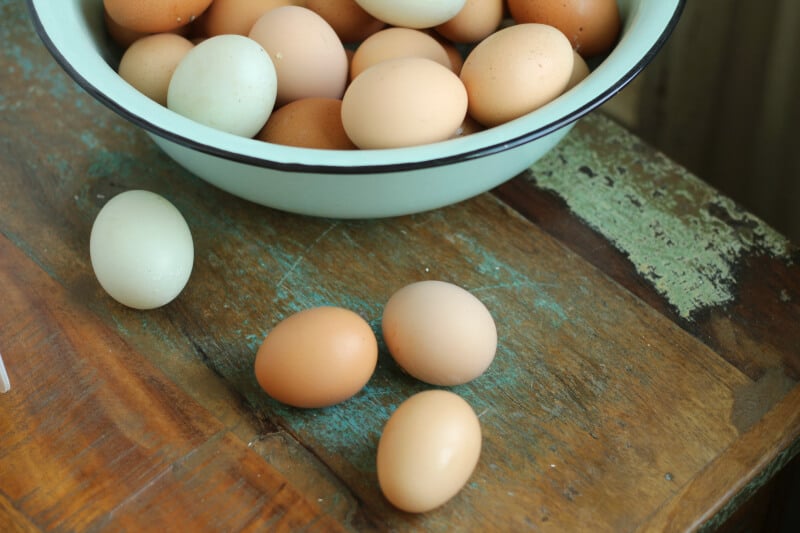
You actually do not have to keep fresh eggs refrigerated (if you don’t wash them). And yes, I do keep just a few sitting on the counter occasionally in a special antique bowl. They are so pretty, I just like to enjoy them that way.

What? No Refrigeration? Won’t We All Die?

Here’s the deal.
In America, we are required to refrigerate eggs because of the factory farming practices. The USDA requires that an American egg be power-washed (because many factory farm chickens carry salmonella) and this washing removes the natural layer of protection that an egg has when it is laid. The natural layer of protection prevents contamination through the tiny pores of the egg. So after being washed, a factory egg is then coated with a thin layer of oil to offer some protection from contaminants and drying out.
In Europe, no one refrigerates their unwashed farm eggs. They are naturally protected by their own coating and sold in stores unrefrigerated. If the chickens do not have salmonella, the egg stays safe but will eventually go bad with time in a natural way. And since your backyard flock should not have salmonella, you can do the same.
So yes, you can keep home-harvested eggs out of refrigeration FOR SHORT PERIODS OF TIME as long as you DO NOT wash off the protective coating. Take them from the hen to your counter without rubbing or scrubbing. Then wash them just before you are ready to use them.

Am I Sure?


Maran Chicken Eggs
I went to culinary school and I went through food safety certification through the extension service when I studied to be a Master Food Preserver. I took all the food safety courses. I know full well the science behind food poisoning via the egg. We were taught never to let an egg stay out beyond 4 hours. And that is absolutely true – for factory farmed, store bought eggs.
But after studying all the facts and talking to other homesteaders and farmers AND seeing for myself how farm fresh eggs are handled in Europe. I feel okay sitting a few of MY eggs out on the counter for a week at a time. My chickens are healthy and no one in my family is health compromised (which would make it too risky). You need to decide for yourself based on your situation.

Now A Few More Points:

  1. I am not suggesting that you keep those eggs on the counter for months. I know many who do this. But for me, 1 week is within my comfort zone. Keep in mind that a room temperature egg will go bad faster than a refrigerated one. I believe a counter egg will keep well past 2 weeks, but for me, if it looks like it is going to be longer than 1 week before use, I refrigerate.
  2. I would NEVER do this with store bought eggs because they are washed and probably contaminated.
  3. Would I do this with farm fresh eggs from the farmer’s market? Perhaps. IF I knew the farmer and could be assured that his flock is healthy. But for me, it is the fact that the eggs came from my hen that make me feel confident in keeping just a few on display on my counter.
  4. Here is a link to a pinterest pin with info on testing an egg for freshness. Handy to know!

Egg Skelter:

I have noticed that for some homesteaders the idea of displaying eggs can be a big deal. In Europe, it is very common to use an egg skelter for this. What is a skelter, you ask? 
An Egg Skelter is a way of storing your eggs so that the first ones IN are the first ones OUT. Chicken owners know that it can get confusing as to which are the oldest eggs you have collected. It is best to have some sort of system.
Well, this little stand keeps it organized for you. It is meant to be used on the kitchen counter and does not fit inside the refrigerator very well. I searched for weeks for one here in America until I finally discovered one from Manna Pro. (And no, I do not get anything for mentioning this company. I just wanted to share the link of where I found one.)

Tuesday, September 11, 2018

Natural treatments for mites

7 Natural Ways to Treat Chicken Mites and Stop Them Returning


The good news is that chicken mites live on chickens (in general) – not people, although they can and will bite you possibly causing a local skin irritation.
If left untreated mites can be extremely harmful to your chickens and can even result in a drop in egg production.
Our article today will tell you how chickens catch mites, how to check for them, how to treat a mite infestation and finally, prevention.

5 Most Common Types of Chicken Mites

We are going to meet five members of the mite family today:
  • Northern fowl mites
  • Red roost mites
  • Scaly leg mites
  • Depluming mite
  • Tropical fowl mite
Mites can be whitish-grey, dark brown or red in color – they are very small, about 1/26 inches and barely visible with the naked eye.

How do Chickens Get Mites?
Mites will hitch a ride to your beautiful clean coop on just about anything. Wild birds, rodents and other animals, on your boots and clothing, even on you!
If you exhibit your birds at local or national shows there is always a chance that your bird can pick up some unwelcome guests.


Northern Fowl Mites
This is probably the most common and serious of the mite family here in the US. The Northern fowl mite spends its’ entire life cycle on the bird.
An infestation in a large poultry house can cause economic downturns by reducing the egg laying output to around 15% in severe infestations.
The mite causes skin irritation to the birds but also bites and sucks blood which can lead to anemia.
An anemic hen will look depressed, scruffy, feathers will be ratty, and she will pick at herself leading to sore or bald patches on the skin. As the infestation worsens she will also be off her food, egg production will drop and she may die from anemia.
Birds over 40 weeks of age do not generally support a heavy load of mites.
The eggs of this mite are laid at the base of feathers and can be difficult to spot. Although the female mite only lays a few eggs before she dies, an infestation can develop very quickly if left untreated.
The preferred temperature of the mite is around 65-68F but they can proliferate outside of that range. They can be a problem in the cooler, moister months especially in the Northern states.

Red Roost Mites
The red roost mite is the primary mite of Europe. This mite causes thousands of Euros worth of damage to the European poultry community every year.
Most of the mites’ life cycle is off the host, hiding in nooks and crannies such as perch sockets. They are night-time feeders, they hate daylight. The female feeds on blood and the male will only take blood occasionally.
The life cycle is 7-10 days in length over which time an infestation can quickly become established. It is difficult to eradicate since the mite can live around 10 months without a host!
In serious infestations sometimes the best solution is to burn the coop and put your birds in new premises once they have been treated.
The red mite only attacks poultry and pigeons although it will bite other species such as human.
The bite may cause a localized reaction but should not be any more severe than that.


Scaly Leg Mites
This unsavory little beastie burrows under the leg scales of the chicken where it feeds on the keratin contained in the scales.
In time, the scales will lift up and will have a white, dusty appearance.
These mites are extremely irritating and can cause a lot of pain to the bird. In severe infections the combs and wattles can also be attacked.

Depluming Mites
This mite is related to the scaly leg mite but attacks the feathers instead. It will burrow into the shaft of the feather sucking the nutrition out of the released fluid.
Extremely irritating and painful – it will cause the bird to pluck out her own feathers.

Tropical Fowl Mites
This mite is a relative of the Northern Fowl Mite, but is much more of a nuisance to humans. It is found in the southern and central states of the US, South America, Australia and other tropical venues.
It can have serious impact on commercial poultry farms if the infestation is severe.
It can even be passed to humans and can set up human infestation. The usual sources of infestation in human housing are wild birds’ nests in the eaves of the house.
When the birds leave the nests they leave the mites behind who then go in search of a meal.

Signs and Symptoms of Mites


The signs of infestation for these pests are approximately the same for each one of them.


In general the bird(s) will look unhappy, depressed, hunched over; feathers will look tatty, unkempt; the bird may constantly preen and pick at herself leading to broken or plucked feathers and bald spots.
In severe infestations appetite will diminish and egg laying will drop dramatically.
You might notice a reluctance to go into the coop at night – this is the time that the mites are really active especially the red roost mite.
  1. The Northern fowl mite, red roost mite and tropical fowl mite all suck blood, so your hen will get anemia and if left untreated she may die.
  2. The Scaly leg mite will cause extreme irritation and pain to the legs. This one is tough to spot since the mite remains hidden all the time. The first you may notice is the lifting of the scales and increased leg girth, by which time you have a fairly well set infestation.
  3. The depluming mite attacks the feathers, so you may notice the bird frantically pulling at her feathers and preening incessantly. This can lead to bald spots and sores on the body.
All mites are incredibly small – they can be seen by the naked eye if you have great vision.
A telltale cluster of eggs at the base of the feathers can lead you in the right direction, but red mites and scaly leg mites do not lay eggs at the base of the feathers.How to Get Rid of Chicken Mites
We have divided the treatments into natural and ‘chemical’. Some folks swear by the natural remedies and yet others will tell you they don’t work.
Several of each are mentioned here, but this does not mean an endorsement of the product be it natural or otherwise.

Natural Ways to Treat Mites
Herbs and natural oils have a huge following among ‘natural’ chicken keepers.
The use of strong smelling herbs in the coop can prevent several types of critter from invading your coop; think mice, ants etc.
Herbs such as lavender, wormwood, mint, lemon balm are all quite aromatic and in addition to deterrence they make the coop smell good.
There are several ‘recipes’ on the internet with regard to mixing herb bouquets for putting in the nest boxes and sprinkling around the coop. The use of garlic is highly recommended by many proponents for preventative measures for many chicken ailments.
Specifically for scaly leg mites, the use of Vaseline is recommended. You spread it thickly on the legs working against the scales. This ensures that the ointment gets up under the scales and suffocates the mite.
It is not a ‘quick fix’- treatment will need to be repeated several times to be effective.
In the ‘old days’ chickens would have their legs doused in kerosene or motor oil to kill the mite. Yes – it worked, but the discomfort must have been awful.


Neem oil is use by many folks on perches and in nest boxes. You spray the Neem solution on the perches and around the crevices, spray the nest boxes also. Let it dry before you let the hens back in.
A naturally occurring insecticide is rotenone or derris (pestene in Australia). This can be used for many garden pests such as caterpillars and aphids. Although naturally occurring, it is not without side effects – highly toxic to fish and has been linked with Parkinson’s disease in farm workers.

A relatively new product to the market is Elector PSP. It has been around since 2008, so can be considered a relative newcomer to some of the more established treatments.
It contains spinosads – naturally occurring soil bacteria which are toxic to insects. The safety sheet states that it is safe to use on many types of livestock including poultry. No known side effects for humans either.


Diatomaceous Earth – has become controversial over the last few years. You either love it or hate it. It is said to control mites, lice etc. Yet other folks say it doesn’t work at all. The biggest downside to DE is that it is mined in open pits which are not good for our environment.


Chemical Ways to Treat Mites
Now we move on to the chemical weapons used in the ‘insect wars’.
Possibly the most abused chemical in use with chickens currently is Ivermectin. I must have read hundreds of posts about folks treating their birds without veterinary approval.
There is no doubt that it is effective against mites and lice, but it is not approved for use in poultry. It has not been tested on birds that are a meat or egg laying flock. It can be administered with a veterinarians’ approval, but this is based on clinical judgement.
There is an egg withholding period of 14 days if Ivermectin has been used.
Probably one of the most popular dusting agents used is Sevin. It has been around for years and is common in many yard and garden products in use today.


We all tend to forget that Sevin (carbaryl) is an organophosphate poison, as such it is indiscriminate in its’ toxicity. Small mammals and children are highly susceptible to it and adults too can be affected.
In fact, most of the other insecticides used with poultry lice and mites are organophosphate:
  • Coumaphos – Co-Ral
  • Tetrachlorvinphos – Rabon 50
  • Tetrachlorvinphos/dichlorvos – Ravap EC
Fortunately, most of these are reserved for use on industrial sized poultry concerns. This article gives some good information on the various mites and insecticides used for them.

How to Prevent Chicken Mites

Prevention can be summed up in one word – biosecurity. Practicing good biosecurity will help to minimize the chances of an infestation in your flock.
Do your best to eliminate wild birds from the area where your flock is – cover runs with mesh so they can’t get in. Provide a dust bathing area for your ladies, they will love you for it and keep down the ‘undesirable residents’ themselves.

Clean up any feed spills to deter visiting rodents or larger animals. Maintain a vigorous program of rodent eradication in and around the coop – put the cat to work! We have already mentioned the use of various herbs as a deterrent for pests in the coop.
Keep one or two sets of clothing for dealing with your flock separate from anything else. If you visit shows or a friend who keeps birds, change those clothes before dealing with your birds.
If folks want to visit your flock, try to politely say no, but if not they should wear protective foot covers at least.
Maintain clean feeders and drinkers. In this case ‘cleanliness is next to Godliness’ for your birds’ safety and well-being.


Check your flock, especially broodies regularly – more frequently in the summer months. If you buy new birds, they need to be isolated for a minimum of 15 days – longer is better.

Summary

Mites are nasty and difficult to get rid of once they move in. Practicing good biosecurity will help to prevent them from inviting themselves into your coop.
However, even with the best practices and intentions, you can still get an infestation, so be vigilant.
If you suspect your birds have mites, try to confirm with a visual sighting, but if that is not possible, proceed as if they do have them.
Isolate infected birds if feasible, treat all birds, treat the coop and environs, and destroy litter/bedding (moving it to the compost will only relocate them). Clean down the coop with an approved disinfectant such as Virkon S.
If you do have to use some of the more potent insecticides on your flock, be aware of the side effects of the treatment – for the safety of your birds and you.
We hope you never have to deal with these tenacious beasties, but if you do, you are now well armed with choices.


Monday, September 3, 2018

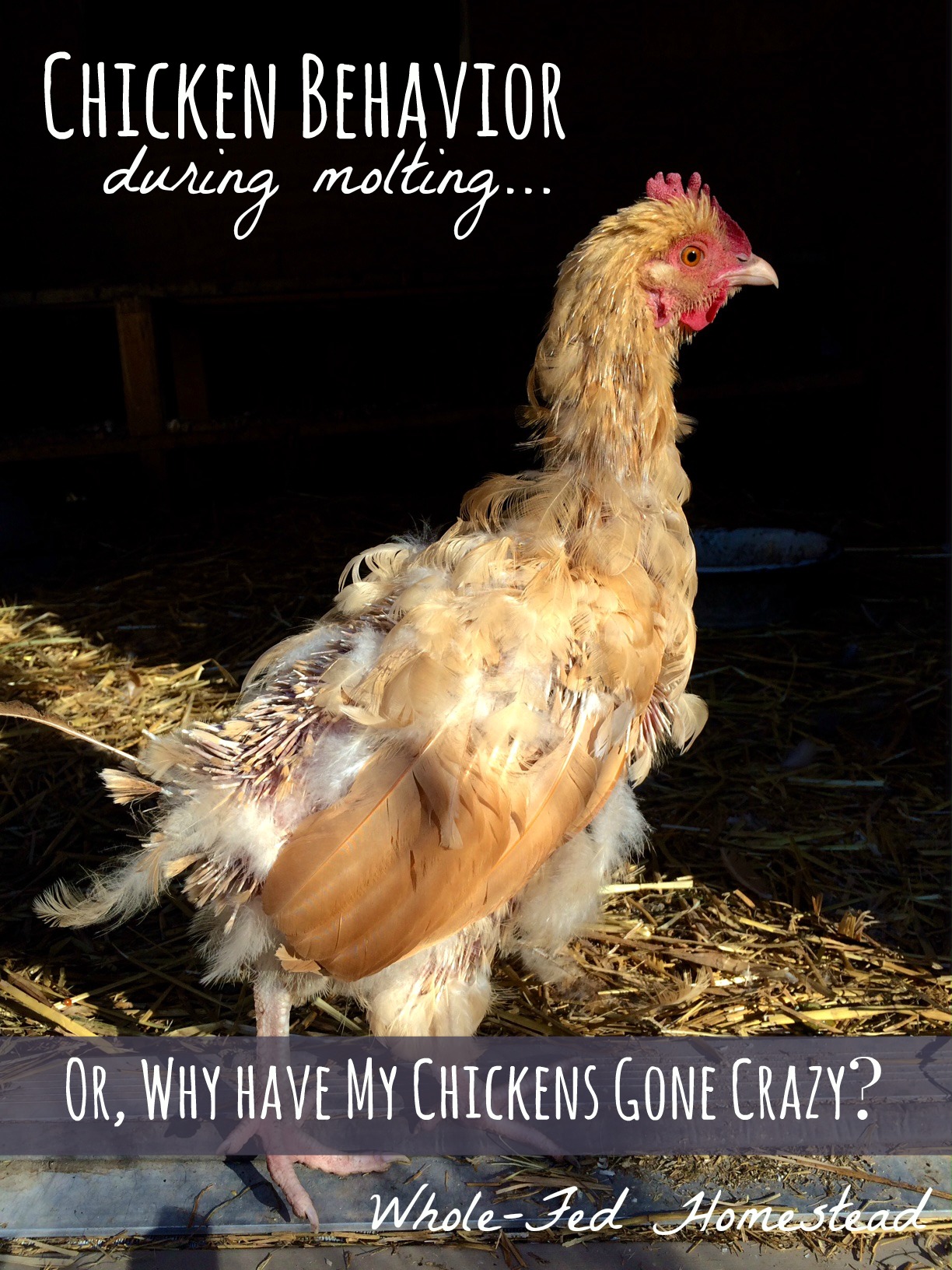
Chicken Behavior During Molting

Chicken Behavior During Molting… or, Why Have My Chickens Gone Crazy?!


Chicken Behavior During Molting... or, Why Have My Chickens Gone Crazy?! Strange and odd behavior during a molt. | Whole-Fed Homestead 
   
Not only do they provide us with meat and eggs, but chickens are pure homestead entertainment! Spending even a few minutes out in the fresh air and sunshine with these birds will always put a smile on my face. I love just watching them- and actually, keeping an astute eye on them is part fun and part necessity.
Knowing their normal behavior (and they’re all different!) is the key to knowing when something is off, and being able to intervene if they’re sick, before it’s too late.
Lately a few of ours have been acting strange. It started about a month ago just before the girls went into a really hard molt. The group of chickens we have now are our first, and they are about a year and a half old, so I knew their first major molt would be starting anytime. I had never seen chickens go through a molt before, so I didn’t know quite what to expect.
I did expect that they would lose a lot of their feathers and look like ragamuffins. And I knew that they would need extra protein in order to grow those feathers back with the least amount of stress on their bodies. What I wasn’t prepared for were the behavior changes…
Abe Lincoln
First it was Abe Lincoln. Now, she’s always been one of the oddest chickens- very spastic and reactionary. She always looks me right in the eye super-intensely, like she’s enticing me to have a staring contest. She knows her name, and I’ll call for her under my breath, like I’ve got a secret to tell her and I don’t want anyone else to hear. Then I feed her a small handful of sunflower seeds before anyone else can get there… Abe is the smallest of everyone, so I think she appreciates the extras.
Chicken Behavior During Molting... or, Why Have My Chickens Gone Crazy?! Strange and odd behavior during a molt. | Whole-Fed Homestead


See what I mean?!
One day during the afternoon chicken-check, I noticed she was acting strange. Everyone else was milling about as they usually do, and she was sitting in the run all by herself. Uh oh, that’s never a good sign. I launched into chicken-crisis-prevention-mode and went to check on her. I checked her over, she protested but wasn’t flighty, and I couldn’t find anything wrong with her. She wouldn’t even take the sunflower seeds I offered her. I checked on her every couple hours for the rest of the day.

The next day there was no change: still all by herself all day, just sitting there quietly.Day three was the same. I didn’t know what to think- no one else was acting funny?!
Day four came and she pepped up a little bit. She started mingling with the rest of the flock again, and… she was missing a ton of feathers. They were falling out of her with almost every move she made!
Her behavior returned to almost normal slowly over the next few days, and she was extra flighty for the couple weeks it took her to grow her feathers back. Her beautiful grey beard- her namesake, has been the last part to get feathers back.


Val
She knows her name and comes running when I call it… she’s just a sweetie, and one of my best chicken buddies. She is trained to jump on my forearm when I put it down and offer it to her. She likes to perch on my shoulder and when I sit in the lawn chair she’ll jump in my lap and fall asleep. We catch grasshoppers together, i.e., I shuffle my feet through the weeds and she gobbles them down when they jump up.
Val’s molt was different, but equally strange. One day she completely changed. I could see she was starting to lose some feathers- nothing too major, a few here and there. Like night and day she became flighty and scared, of everything and everyone, including me. She ran when we walked towards her and she wouldn’t even come to the offer of sunflower seeds. Previously she would have been crawling all over me to get them. Now she didn’t want anything to do with me.
I wondered if there was a predator that had spooked her, or if another hen had been beating up on her to make her act this way. Maybe something had scared her? Just like Abe Lincoln, I inspected her and could find nothing wrong. She also stopped roosting and started sleeping in the nest box. I normally wouldn’t allow that behavior, but the poor girl was nearly bald and the hens can get pretty mean in the evening fighting over the best roosting spots. I’m a push-over.


Chicken buddy; Chicken Behavior During Molting... or, Why Have My Chickens Gone Crazy?! Strange and odd behavior during a molt. | Whole-Fed Homestead 
   
This behavior continued for almost two weeks, as she lost a ton of feathers and then re-grew them. Just this week we rekindled our friendship. She’s got a beautiful full set of shiny new feathers, and she’s back to her old self: sitting on my lap and roosting again.


Little Henny
And then there’s Little Henny. Poor, poor Little Henny.
We have four Buff Orpington hens, and when we first got them we couldn’t tell them apart, so we just referred to them all as “Henny.” As they got older and became easier to distinguish, they all adopted new name variations. There’s Mama Henny, Regular Henny, and two Little Hennys (still can’t always tell those two apart). We’re original, I know.
Similar to Abe Lincoln, before losing her feathers Little Henny started acting funny. Three days in a row she refused to come out of the coop. She stayed on the roost nearly all day. And bless her heart, one of her friends stayed by her side and kept her company for two of those days. Chickens are so cool- they don’t get nearly enough credit as a species. They absolutely do have personalities and feelings!
Of course I checked Little Henny over, and again there was nothing obviously wrong. I left her alone and kept an eye on her from a distance. Over the next few days she lost almost all her feathers. I wasn’t surprised… by the time she was exhibiting this weird behavior, I knew to expect a molt, especially when everything else checked out okay.


Henny molting; Chicken Behavior During Molting... or, Why Have My Chickens Gone Crazy?! Strange and odd behavior during a molt. | Whole-Fed Homestead 
   
She’s starting to come around now- although she has taken a little longer to get her feathers back than some of the others. She is also one of the smaller chickens, so I have made it my daily mission to see that she gets some extra nutrients.


But Why the Odd Behavior?
I’m not sure what the internal mechanism for the odd behavior is. Is it hormones? Is it simply because they don’t feel good? I mean… growing new feathers hurts. And it takes a lot of energy to do. Does it frazzle them because they are more visible to predators, and with less wing feathers and less energy it’s tougher to fly away?
My observation is that the anti-social behavior is due to their fear of being pecked on their bare skin. Beaks hurt when you don’t have layers of feathers to protect you from them! I’d shy away from the other flock members too if I were bald. Nor would I want a rooster jumping on my poor bald back. It’s almost like molting sends you straight to the bottom of the pecking order.
I’ve also noted that we have plenty of chickens that molted just fine, with no real behavioral changes. Just like people, they really are all different!
What Can We Do to Help?


Increase the protein in their feed. Try these out-of-the-box protein suggestions, or simply switch from a layer ration to a grower ration. Spring for a bag of dried mealworms, or raw sunflower seeds to help them through!
Reduce stress, be respectful. Don’t pick them up against their will, even if you really want to; don’t be selfish. For their own good- fine, for yours- no. It hurts to be handled when you’re molting. Just let them be. And make sure any children understand this too.
Don’t introduce new flock members, change housing, or do anything else out of the ordinary. Don’t allow big groups of visitors, rowdy kids, or strange dogs near where the chickens call home.
Make sure there is always food and clean water available. Our hens free-range, so I usually let them fend for themselves in the morning, and feed them in the afternoon. Since they have been molting, everyone gets a higher protein feed first thing in the morning. I feel bad making them find their own food in the morning when they obviously don’t feel 100%.


Practice Good Animal HusbandryI think that one of the most important things you can do as an animal care-taker is be observant and pay attention to detail. Know what normal looks like, so you can tell when something isn’t normal.


Monday, August 27, 2018

All my chickens are laying...What Now!!

Ways to Use Extra Eggs

ways to use lots of extra eggs

Big eggs, little eggs, brown eggs, blue eggs…

That was my best attempt at a Dr. Seuss impression… But yeah, my life can be summed up by a single word at the moment: EGGS.
The ducks are laying, the chickens are laying, I have eggs in the incubator (ready to hatch this week… eeek!), eggs on my counter, eggs in the basket, eggs falling out of my fridge. I’m drowning in eggs.
I’m giving them away, and we’re eating lots of scrambled eggs for supper, but they keep on coming. And coming… And coming. I know I’m not the only one with this wonderfully delicious problem, as I’m hearing a lot of you mention this exact same predicament lately.
So may I present– a big ginormous list of wonderful, amazing, tasty ways to use all your extra eggs. Some of these feature eggs as the star (like frittatas or crepes), while others just call for 3-4 eggs per recipe (like the quick breads or homemade pasta). Regardless, they are all good ways to put your egg stash to good use.
(You’re welcome)

50+ Ways to Use Extra Eggs

should you wash eggs?

The Eggy Basics:

Preserving & Fermenting Eggs:

ways to use lots of extra eggs

Breakfast Ideas Made with Eggs:


Breads with Extra Eggs:

eggs-home

Lunch & Supper with Eggs:

ways to use lots of extra eggs

Desserts Made With Eggs:

Eggy Odds & Ends:


Monday, August 20, 2018

Collecting, storing and hatching chicken eggs

Raising Chickens 101: Collecting, Storing, and Hatching Chicken Eggs

Related image


Once you’ve eaten farm-fresh eggs, it’s hard to go back to grocery store eggs. Fresh farm eggs, free-range or not, are delicious, with bright yolks and firm whites. Give your hens ground oyster shell or a similar calcium supplement, available at farm suppliers, for strong eggshells.

Collecting Eggs

You’ll want to collect eggs every morning; hens cackling loudly are a sign or clue that they’re laying. I usually have another look in the afternoon, as well.
Oddly enough, chickens like to eat eggs as much as we do. Most egg-eaters learn on broken eggs and then begin to break eggs themselves. Chickens are opportunists and will pick at whatever looks edible. If you clean up broken eggs immediately and throw out any “eggy” straw or shavings, you can prevent egg-eating. A chicken that learns this habit can’t be cured, and others may follow her lead. You don’t want the chickens eating your eggs—you want them yourself!
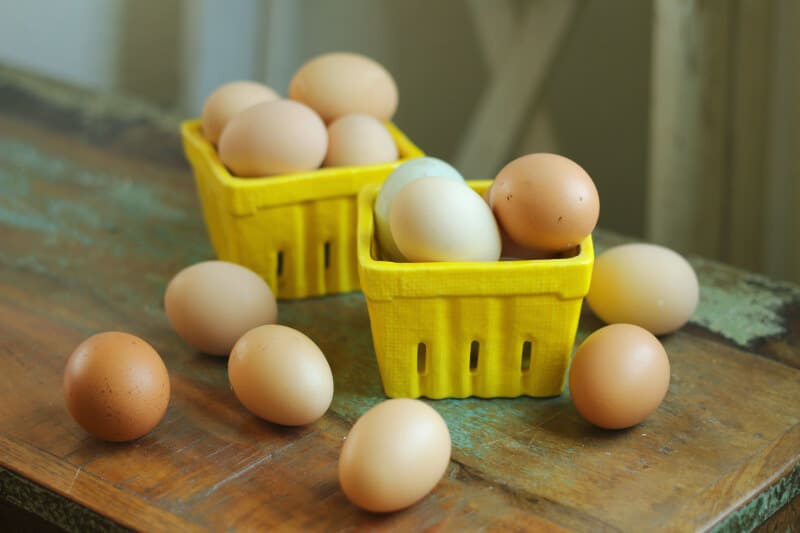
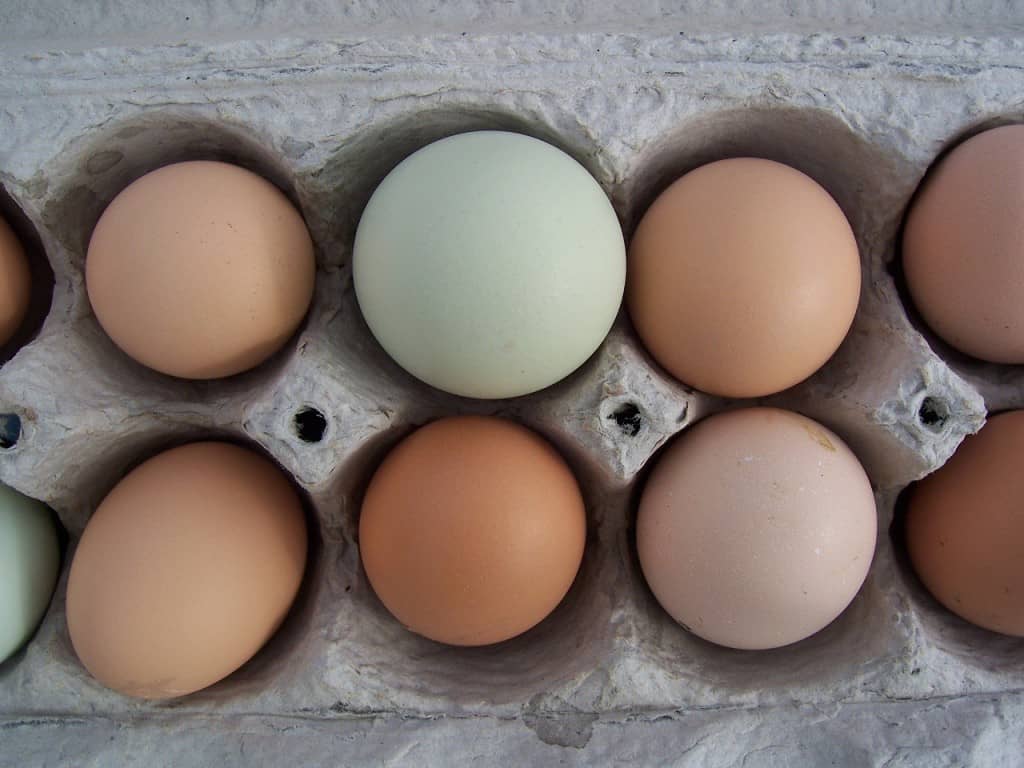
You can tell what color eggs a hen will lay by the color of her ear. Yes, her ear. Birds don’t have external ears like humans do, so look for a small circle or oval of skin on the side of the head, next to the ear hole. If it’s white, your hen will lay white eggs; if it’s red, she’ll lay brown ones. There’s no difference in flavor or nutrition, but white eggs show the dyes more brightly at Easter! (Especially natural dyes, as pictured here.)


Cleaning and Storing Eggs

Eggshells have a “bloom,” a natural coating that protects the egg from bacteria. Avoid washing your eggs if you can; instead, wipe with a dry, rough cloth.
If the eggs have a little manure on them, you can wipe with a damp cloth for small spots. A really dirty egg can be submerged and scrubbed with a vegetable brush. Always use warm water; cold water will make the egg shrink inside the shell and will draw in bacteria.
Let eggs air-dry thoroughly before putting them away. (I like to sort them by color, darkest to lightest, but that’s just me!)
Put them in dated egg cartons, and store them in the fridge on a shelf—not the door, where they will get jostled with every opening/closing. For partial cartons, I mark each egg in pencil with the day it was collected. Fresh eggs are good for a month in the refrigerator.
A cooking tip: To make deviled eggs, use week-old or older eggs, not this morning’s. The shells of really fresh eggs stick and don’t peel cleanly.

Hatching Chicken Eggs

If you want chicks, you’ll need a rooster. As a rule of thumb, 10 to 12 hens per rooster is a good ratio. While you could build an incubator and supervise the development of the eggs, it’s easiest to let the hens take care of hatching.
A hen that is getting ready to nest becomes “broody.” This means that she wants to hatch her eggs. She’ll sit “tight” on the nest and resist having her eggs collected, whereas a non-broody hen will let you reach under her to collect eggs. A broody hen may even peck or screech at anyone coming near. There are ways to discourage broodiness, but why would you? The hen does all the work of hatching and raising—and you get free chicks!
If you do decide to get an incubator, a forced-air model with an automatic egg-turner is recommended, as eggs will need to be turned four to five times a day. The temperature inside the incubator should be between 99° and 102°F, while the humidity should remain between 55 and 60%. Chicken eggs will hatch after approximately 21 days. Check with your local cooperative extension service for more information.
Farm chickens can live 4 to 7 years and lay eggs for most of that time. Every year they go “off-lay” (stop laying eggs) for several months. This happens over the winter, when there’s too little daylight to trigger egg-laying. They’ll begin again in the spring.
See what to do when chickens stop laying eggs.

More of Raising Chickens 101

See more of our beginner’s guide to raising chickens:


Thursday, August 16, 2018

Odd Eggs? We all get one from time to time

10 Abnormal Chicken Eggs & What You Need To Know!

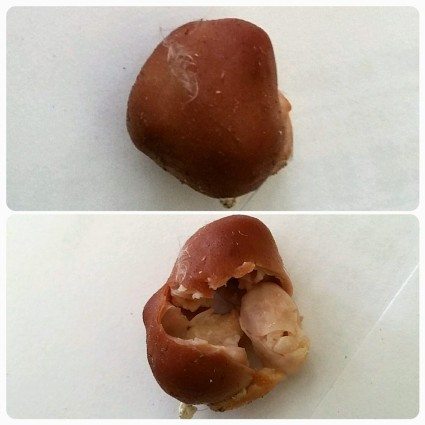
So...I have to ADD my own experience of something weird inside of MY chicken egg. Last night I was cooking eggs for dinner, cracked three into the pan, the fourth had a strange oblong dark brown "thing" inside of the egg white, not the yoke. In hindsight I should have taken a photo of it in the pan. The egg was fine, I dished out this "thing" and finished cooking my eggs. When I examining it later...I am totally puzzled! It is rock hard, looks and feels like a small heavy rock but smooth surface, almost like a piece of iron. The hen has only been laying for a month. I have yet to find anything that describes it in my searching. I will post a photo on my facebook group. Anice
 

Abnormal chicken eggs: If you own chickens, it’s just a matter of time before you get one that makes you scratch your head and wonder “What the heck?”


Don’t worry. Usually, abnormal eggs just happen, and although they can mean your chicken is sick or stressed, they aren’t necessarily something to be concerned about. 

(New to chicken keeping? Grab my bestselling book Chickens: Naturally Raising A Sustainable Flock for less than the price of takeout here!)


Your chicken is a live animal, and sometimes, just like humans, things go awry without explanation.

There’s a few abnormal eggs you’ll likely run into regularly, while others are uncommon (although clearly not unheard of). 

If you’d rather learn about abnormal chicken eggs by listening, you can download my podcast about it here:


It’s important not to get too concerned about abnormal chicken eggs – while they can indicate a problem, your best bet is to watch your flock for signs of stress or illness, and remember that sometimes abnormal chicken eggs just happen.

With a couple of exceptions, abnormal chicken eggs are still okay to eat (and I tell you which ones aren’t!).


1. Soft Shell/No Shell Eggs

It can be unnerving (and kind of cool) the first time you see chicken eggs without their shell. The eggs can be missing the whole shell or just part of it, but the membrane is still intact.


Adding the shell is one of the last steps a chicken takes to produce eggs, and sometimes, for a variety of reasons, that step is skipped.

In pullets, soft shell eggs sometimes happen with her first egg – the pullet’s system just hasn’t kick started correctly, but it will soon catch up.

Sometimes the cause is insufficient calcium, which can happen with a chicken who’s been eating a grower ration that’s lower in calcium than a layer feed. 

In established layers, there’s a few reasons for abnormal soft shell eggs, including insufficient calcium or protein absorbed, inflammation of the oviduct, or heat stress. Hens also coming back into laying can lay abnormal soft shell eggs.

Another reason is if the previous egg stayed too long in your chicken’s shell gland, causing the soft shell egg to be laid too soon.  

Can you eat it?
If the soft shell chicken eggs remain unbroken until I find them, I usually feed them to the pigs or throw them on the compost pile.

Although they might be okay, I’m personally not comfortable eating them because I don’t know what kind of nasties have passed through the membrane.


2. Lash Eggs


Among the most disturbing of abnormal chicken eggs to see is a lash egg.

Lash eggs aren’t actually eggs, but rather the result of an infection called Salpingitis – an infection and inflammation of the oviduct. Lash eggs are generally shaped like eggs, since they still travel through the oviduct.

Lash eggs are the accumulation of pus, egg material, and possibly tissue laid by the hen. It can be soft or hard, and is comprised of layers of the shed material. 

Got funky eggs? Abnormal chicken eggs happen to all of us - it's just a matter of time. Here's 10 weird eggs and everything you need to know. From FrugalChicken
Photo courtesy of Timber Creek Farm

While some chicken keepers ring the death knell if they have a chicken that lays abnormal eggs like lash eggs, the bottom line is it’s an infection – consult your vet to see if it can be treated. 

Can you eat it?

You’d be crazy to eat a lash egg.


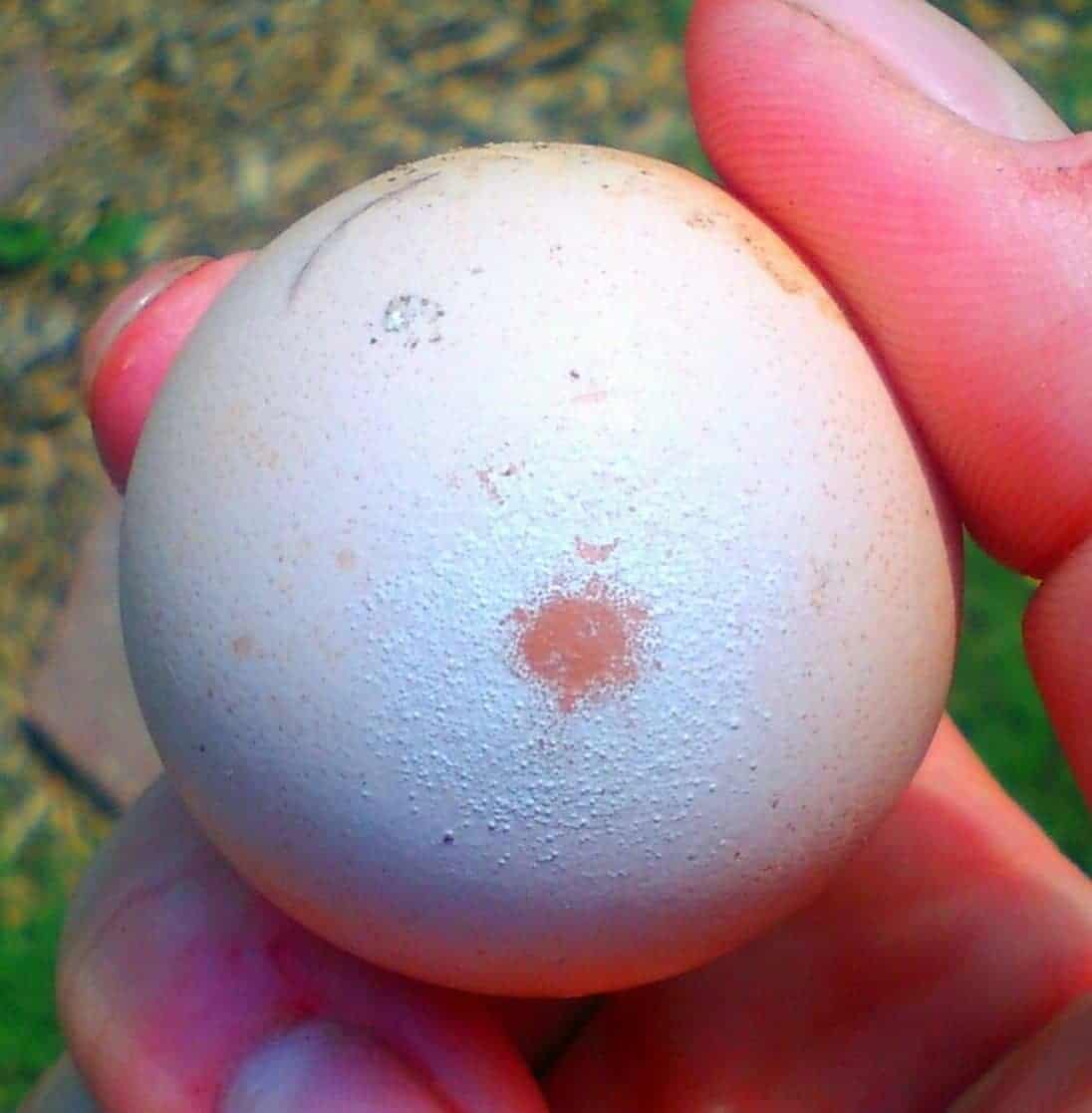
3. Incomplete pigmentation


“I forgot to change the toner cartridge” is a common joke when a chicken owner comes across an egg that’s not uniformly colored.


Eggs not uniformly colored are normal eggs that just have a funny pigmentation that day – it’s a minor flaw.

Abnormal chicken eggs like this is are usually caused by some sort of stress, such as heat stress. The hen is working overtime to keep her body cool – which means she has less energy to put into making eggs.

Poor nutrition or a viral infection are other potential causes.

Can you eat it?

I’ve never had an issue eating chicken eggs with incomplete pigmentation.

4. Bumps on eggs


Bumps on your chicken eggs are calcium deposits – they can range from minor to large deposits, and they’re generally white.

Got funky eggs? Abnormal chicken eggs happen to all of us - it's just a matter of time. Here's 10 weird eggs and everything you need to know. From FrugalChicken

The most common cause is excess calcium in your hen’s diet – check to see if she’s somehow getting too much calcium.

Other causes are defective shell glands or stress during the calcification process.

Can you eat it?
I’ve eaten these eggs without any issues.


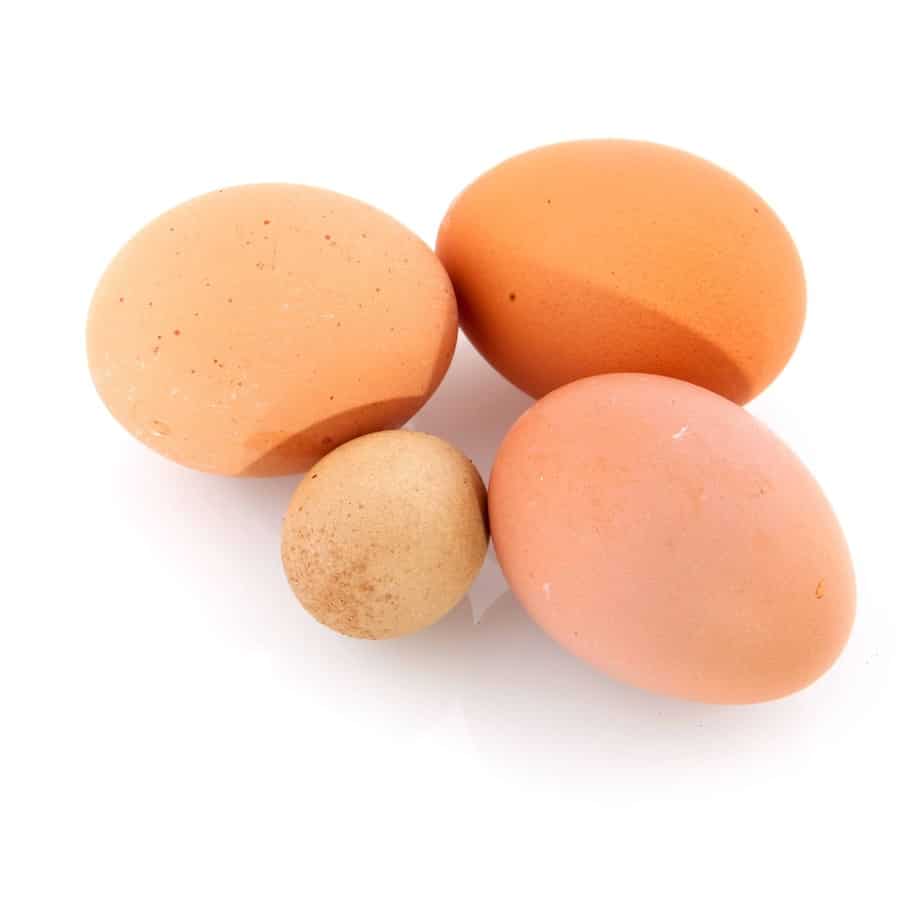
5. Very Small Eggs


Lovingly referred to as fart eggs, rooster eggs or fairy eggs, very small eggs typically are missing the yolk. They’re cute to find, but don’t yield very much in the way of food.

Got funky eggs? Abnormal chicken eggs happen to all of us - it's just a matter of time. Here's 10 weird eggs and everything you need to know. From FrugalChicken

Young pullets might produce fairy eggs when they first start laying – their reproductive system is just trying to catch up.

I’ve also had hens lay fairy eggs when under stress, notably with one hen that had been savaged by a rooster.

Her reproductive cycle might have been disturbed by the stress, or her body might not have been able to produce a real egg because it was putting its energy into healing her body.

Fairy eggs can also be laid when a foreign mass (such as a piece of tissue) triggers the hen’s system to produce an egg.

Can you eat it?
I’ve never had a problem eating fairy eggs.


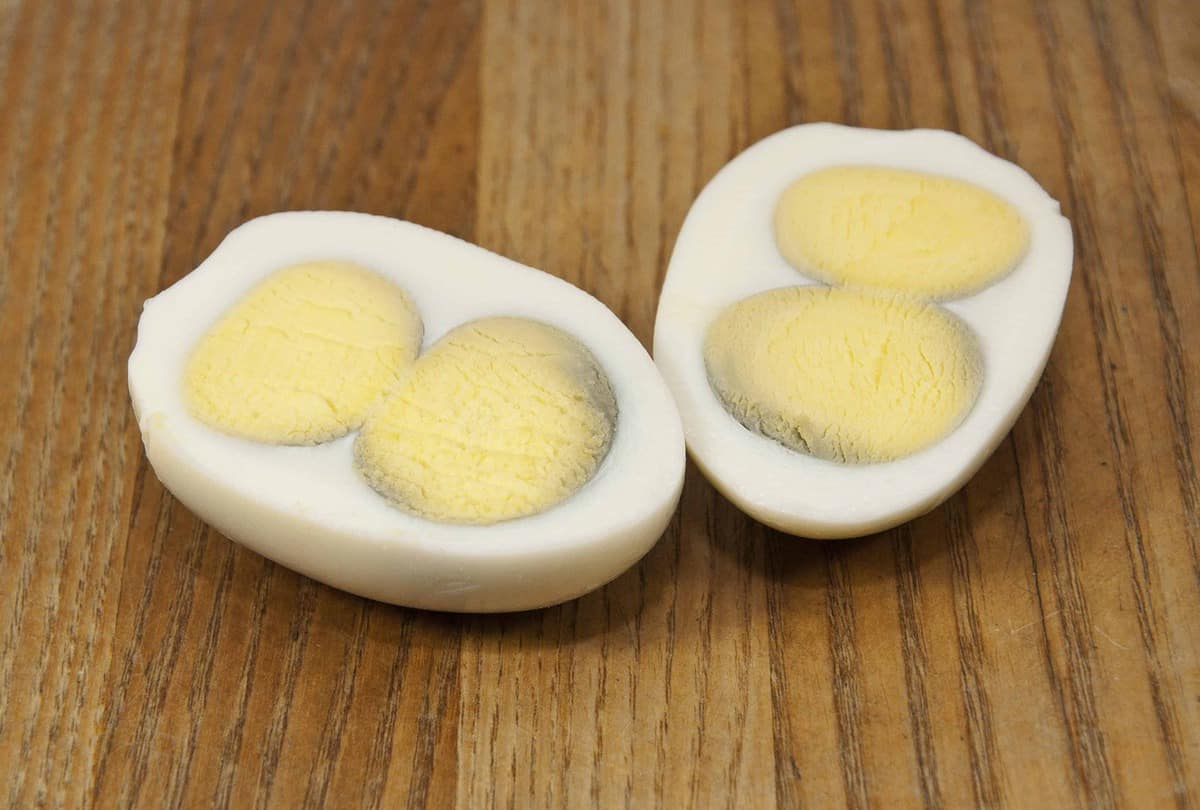
6. Double Yolkers


Double yolkers are always exciting abnormal chicken eggs to find – they will have two yolks in one egg.

Got funky eggs? Abnormal chicken eggs happen to all of us - it's just a matter of time. Here's 10 weird eggs and everything you need to know. From FrugalChicken

Double yolks happen when the hen releases two eggs into the oviduct, and both of those eggs are included in shell. 

Double yolk eggs generally are larger which can be a cause for concern if it’s too large for your hen to pass – causing her to become egg bound or suffer a vent prolapse. 

Although they put stress on a hen’s body, double yolks are becoming so desirable that industrial farmers have bred hens that will only produce double yolked eggs in Europe.

Generally speaking, there’s nothing wrong with a chicken that lays double yolked eggs – it’s just abnormal.

You can incubate it, and there are stories of twin chicks successfully hatching, although it’s rare.

Can you eat it?
People eat double yolked eggs daily.


7. White banded eggs

White banded eggs occur when two eggs enter the oviduct, thereby making contact with each other in the shell gland pouch.

When the hen is forming the shell of the first egg, the normal calcification process is interrupted, so it gets an extra layer of calcium – which is the white band marking. 

Causes for abnormal chicken eggs such as white banded eggs can be something simple, such as flock stress or something more serious such as an infection. 

Like always, your best bet is to watch your flock for abnormal behavior.

Can you eat it?

I’ve never had a problem eating white banded eggs.

8. Egg inside an egg

The fancy name for an egg inside an egg is counter-peristalsis contraction, but in every day terms, they’re eggs that somehow found themselves inside another egg.

It’s not common, but it does happen. 

It occurs when a hen releases a second egg into the oviduct before the first egg has completed the laying process. This causes the first egg to reverse in the oviduct, which is then added to the second egg.

The two then have a second albumen and shell form encasing both eggs.

You can see an egg inside an egg here:


Can you eat it?
Although I’ve not personally dealt with eggs inside eggs, I’ve read reports that they’re perfectly fine to eat. 

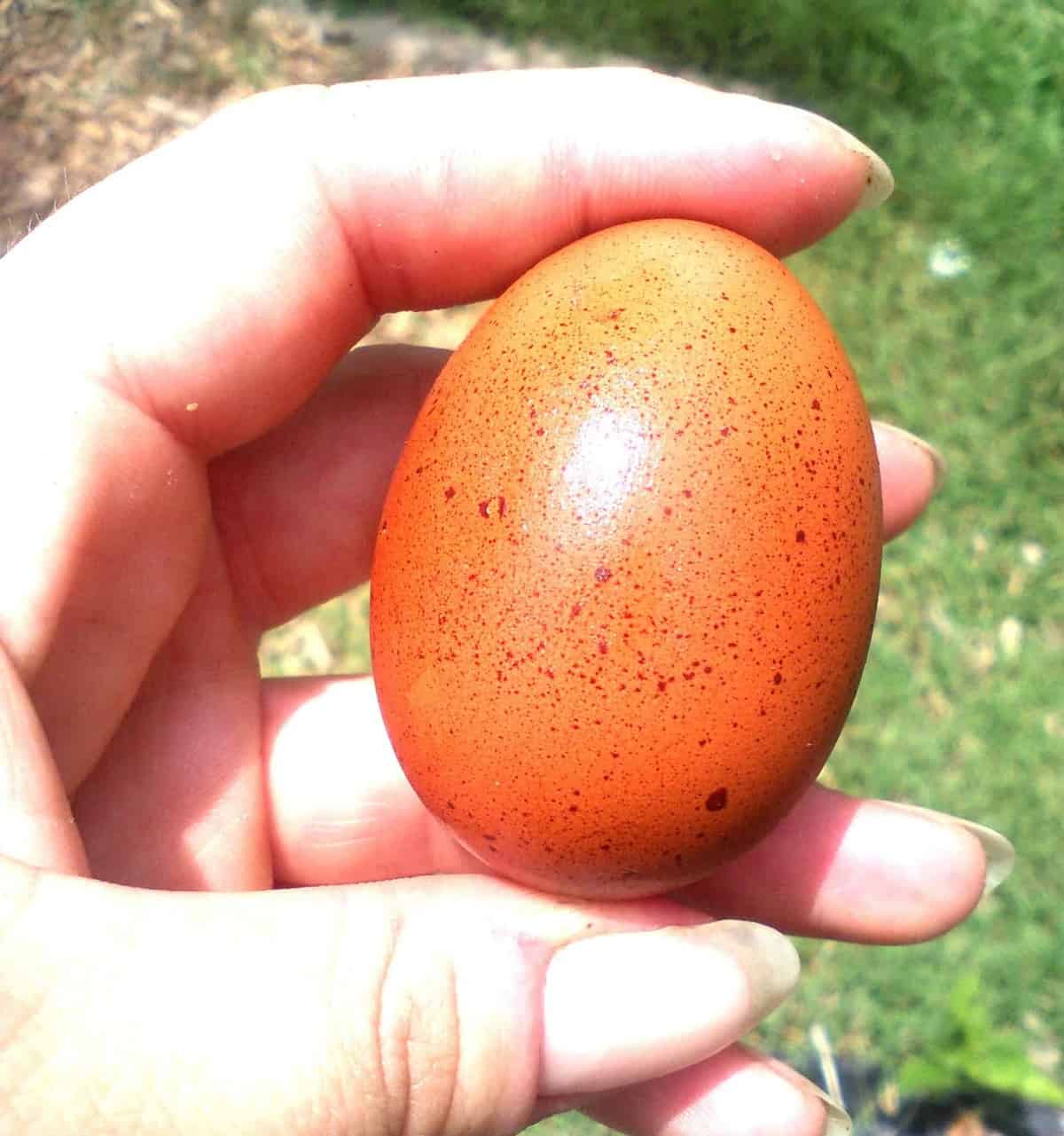
9. Speckled Eggs

Speckled eggs are pretty normal, as far as abnormal chicken eggs go. They look pretty, and it’s wonderful how unique eggs can be.

Got funky eggs? Abnormal chicken eggs happen to all of us - it's just a matter of time. Here's 10 weird eggs and everything you need to know. From FrugalChicken

The speckles are actually extra calcium deposits, and are formed when the calcification process is disturbed or there’s a defective shell gland.

They can also be caused by an excess of calcium.

Although technically abnormal eggs, National Geographic studied eggs, and found that speckled eggs might be a way to make shells stronger – so your chicken might be on to something.

Can you eat it?
I’ve never had a problem eating a speckled egg – they just look abnormal.


10. Odd shaped eggs


Odd shaped eggs are pretty self explanatory – they’re abnormal chicken eggs that aren’t uniformly shaped all the way around.


They might have an abnormal look, like a bulge on one side, or a very pointy end, or just look lumpy.

Odd shaped eggs can occur if there’s some sort of abnormal disturbance in the egg forming process, or if your chicken experiences some sort of stress such as over crowding. Age also makes a difference – it can occur in very old or very young hens.

In rare cases, respiratory diseases can cause abnormal eggsI had a reader tell me her hen always lays odd shaped eggs  – in this case, I would venture to say that since the hen lays consistently, it’s likely a structural issue internally.

Can you eat it?
I’ve not personally had any issues eating abnormal shaped chicken eggs.

While this list of isn’t comprehensive, I’ve touched on the 10 most common occurrences of abnormal chicken eggs. Hopefully you find it useful!