Search This Blog

Wednesday, June 27, 2018

Common Chicken Diseases

https://morningchores.com/chicken-diseases/
I tried to post the photos from this site which I felt were excellent, but I was unable to do so. Please go to the site above to view the entire post with photos. Sorry, Anice

13 Common Chicken Diseases Every Chicken Keeper Should Know About (and How to Treat Them)


1. Fowl Pox


If you notice that your chickens develop white spots on their skin, scabby sores on their combs, white ulcers in their mouth or trachea, and their laying stops then you should grow concerned that your chickens are developing Fowl Pox.
There are treatment options for Fowl Pox. You can feed them soft food and give them a warm and dry place to try and recoup. With adequate care, there is a great chance that your birds can survive this illness.
If you would like to remove the odds of your birds even contracting this disease there is a vaccine available. If not, know that they can contact this disease from other contaminated chickens, mosquitos, and it is a virus so it can be contracted by air as well.

2. Botulism


If your chickens begin to have progressing tremors you should grow concerned. If your chickens have botulism the tremors will progress into total body paralysis which does include their breathing.

It is a serious disease.
You will also notice their feathers will be easy to pull out and death usually occurs within a few hours.
But what can you do about it?
Well, there is an antitoxin that can be purchased from your local vet. Though it is considered to be expensive. However, if you catch the disease early enough you can mix 1 teaspoon of Epsom salts with 1 ounce of warm water. You can give it to them by dropper once daily.
If your chickens have contracted this disease it means that there has been some type of dead meat left near their food and water which contaminated it. Which means this disease is avoidable as long as you keep your chickens in a clean environment and clean up any dead carcass from around their environment.

3. Fowl Cholera


You should be suspicious of this disease if you see your birds begin to have a greenish or yellowish diarrhea, are having obvious joint pain, are struggling to breathe, and have a darkened head or wattle. Fowl Cholera is a bacterial disease that can be contracted from wild animals or food and water that has been contaminated by this bacteria.
But the downside to your chicken developing this disease is there is no real treatment. If by some chance your chicken survives, it will still always be a carrier of the disease.
So it is usually better to put them down and destroy their carcass so it will not be passed.
But there is a vaccine for your chickens to prevent the disease from ever taking hold.

4. Infectious Bronchitis

This disease hits close to home because it wiped out half of our flock when we were new to raising chickens. You’ll recognize this disease when you begin to hear your chickens sneezing, snoring, and coughing. And then the drainage will begin to secrete from their nose and eyes.
Their laying will cease too.
But the good news is you can get a vaccine to stop this disease from impacting your chickens.
However, if you decide against that then you will need to move quickly when seeing these signs. Infectious Bronchitis is a viral disease and will travel quickly through the air.
To treat Infectious Bronchitis, give your chickens a warm, dry place to recoup. I gave my birds a warm herb tea and fed them fresh herbs, which seemed to help.

5. Infectious Coryza


You will know that your birds have caught this disease when their heads become swollen. Their eyes will literally swell shut and their combs will swell. Then the discharge will begin to flow from their eyes and noses. They will stop laying and will have moisture under their wings.
Unfortunately, there is no vaccine to stop this disease.
Once your chickens contract this disease they should be put down. If not, they will remain a carrier of the disease for life which is a risk to the rest of your flock.
Be sure to discard the body afterward so no other animal becomes infected by it.
However, the light at the end of this tunnel is that even though this disease is a bacteria it only travels through contaminated water, other contaminated birds, and surfaces that have been contaminated with the bacteria.
So if you keep your chickens protected from other random chickens and keep their coop and water clean they should be safe from this disease.

6. Marek’s Disease

This disease is more common in younger birds that are usually under the age of 20 weeks.
So you will know that this disease has struck your baby chicks if you begin to see tumors growing inside or outside of your chick. Their iris will turn gray and they will no longer respond to light. And they will become paralyzed.
Unfortunately, this disease is very easy for them to catch. It is a virus which means it is super easy to transmit from bird to bird. They actually obtain the virus by breathing in pieces of shed skin and feather from an infected chick.
And sadly, if your chick gets this disease it needs to be put down. It will remain a carrier of the disease for life if it survives.
However, the good news is there is a vaccine and it is usually given to day old chicks.

7. Thrush


Thrush with chickens is very similar to thrush that babies get.
You’ll notice a white oozy substance inside their crop (which is a space between their neck and body.) They will have a larger than normal appetite. The chicken will appear lethargic and have a crusty vent area. And their feathers will look ruffled.
It is important to mention that thrush is a fungal disease. This means it can be contracted if you allow your chickens to eat molded feed or other molded food. And they can also contract the disease from contaminated water or surfaces.
Though there is no vaccine, it can be treated by an anti-fungal medicine that you can get from your local vet. Be sure to remove the bad food and clean their water container as well.

8. Air Sac Disease

This disease first appears in the form of poor laying skills and a weak chicken. As it progresses, you will notice coughing, sneezing, breathing problems, swollen joints, and possibly death.
Now, there is a vaccine for this illness, and it can be treated with an antibiotic from the vet. But it can be picked up from other birds (even wild birds) and it can be transferred from a hen that has it to her chick through the egg.
So just keep an eye out for any of these symptoms so it can be treated quickly and effectively.

9. Newcastle Disease

This disease also appears through the respiratory system. You will begin to see breathing problems, discharge from their nose, their eyes will begin to look murky, and their laying will stop. Also, it is common that the bird’s legs and wings will become paralyzed as well as their necks twisted.
This disease is carried by other birds including wild birds. That is how it is usually contracted. But if you touch an infected bird you can pass it on from your clothes, shoes, and other items.
However, the good news is that older birds usually will recover and they are not carriers afterward.
But most baby birds will die from the disease.
There is a vaccine for the disease though the US is working to rid the country of the disease all the way around.

10. Mushy Chick


This disease obviously will impact chicks. It usually shows up in newly hatched chicks that have a midsection that is enlarged, inflamed, and blue tinted. The chick will have an unpleasant scent and will appear to be drowsy. Naturally, the chick will also be weak.
So this disease doesn’t have a vaccine. It usually is transmitted from chick to chick or from a dirty surface where an infected chick was. And usually, it is contracted from an unclean area where a chick with a weak immune system contracts the bacteria.
There is no vaccine for this disease, although sometimes antibiotics will work. But usually, when you come in contact with this disease you will need to immediately separate your healthy chicks from the sick ones.
Use caution as the bacteria within this disease (such as staph and strep) can impact humans.

11. Pullorum


This disease impacts chicks and older birds differently. The chicks will show no signs of activity, have a white paste all over their backsides, and show signs of breathing difficulty. Though some will die with no signs at all.
However, in older birds, you will see sneezing and coughing on top of poor laying skills.
This is a viral disease. It can be contracted through contaminated surfaces and other birds that have become carriers of the disease. Unfortunately, there is no vaccine for this disease and all birds that contract the disease should be put down and the carcass destroyed so no other animal will pick up the disease.

12. Avian Influenza

Avian Influenza is most commonly known as the bird flu. It was one of my initial fears of owning chickens because all you hear about on the news is how people get sick with bird flu from their chickens. However, after knowing the symptoms you’ll be able to put that fear to rest.
You need to know how to act quickly if you are afraid your backyard birds have come in contact with it.
So the signs you will notice will include respiratory troubles. Your chickens will quit laying. They will probably develop diarrhea. You may notice swelling in your chicken’s face and that their comb and wattle are discolored or have turned blue.


And they may even develop dark red spots on their legs and combs.
Unfortunately, there is no vaccine and the chickens infected will always be carriers. Wild animals can even carry the disease from bird to bird.
Once your birds get this disease, they need to be put down and the carcass destroyed. And you will need to sanitize any area that the birds were in before ever introducing a new flock.
Use great caution because this disease can make humans sick.
And here is a great resource about avian influenza for all backyard chicken keepers. Hopefully, this will help to put your mind at rest about this disease and your backyard flock.

13. Bumblefoot


Bumblefoot is a disease that you’ll know exactly what you’re looking at when you see it.
It begins by your chicken accidentally cutting its foot on something. It can happen when they are digging in the garden, scratching around in mulch, and so many other ways. But then the cut gets infected. And the chicken’s foot will begin to swell. It can even swell up the leg.
So you can treat it by performing surgery (learn how here.) If not, the infection will eventually take over the chicken and claim its life.
Obviously, bumblefoot can happen very easily and there isn’t much you can do to prevent besides just keep a close eye on your chickens’ feet. If you notice they have a cut then be sure to wash and disinfect it to prevent this disease from setting up.
That is all of the common chicken diseases I have for you today.
However, there are many less common illnesses too. So just be sure to always pay attention to your flock and stay alert to any changes. Never be afraid to research. It is better to overreact than to underreact and miss something that could be detrimental to your whole flock.

Tuesday, June 19, 2018

The Heat is ON! Keep Chickens Cool all Summer long.

10 Brilliant Ways to Keep Chickens Cool in Summer


Chickens can withstand a lot of weather extremes, but heat is not one of them. Did you know that a sudden increase in temperature is more dangerous for a chicken’s health than a gradual temperature climb? Chickens can become very stressed with sudden increases in temperatures and it stimulates blood flow to move away from vital organs and toward other areas of their body, such as, their combs, wattles and skin, thus making them more susceptible to heat stroke.

What Happens When a Chicken Gets Overheated

It is important to understand the dynamics of how chickens react to heat. Since chickens don’t sweat, you must be very watchful over them when the warmer months begin. Our feathered friends prefer temperatures staying between 65 F and 75 F. That’s easier said than done in some parts of the country!
Given that a chicken’s body temperature is 107° F, it is no wonder why they prefer such cooler temperatures. When hens get too hot or stay hot for too long, they can die from heat stress. Typically, their body’s first reaction to heat is panting which helps them keep cool, but increases their respiratory and heart rate, as a result. This leads to expelling carbon dioxide at a much faster rate than normal which upsets the pH balance in their bodies and can lead to acidosis, a potentially fatal condition. Another common sign is the egg laying production will slow or suddenly stop. Here are some other common signs to look for:
  • Are they panting or walking around with their beaks open?
  • Are they hanging their wings out a little distance away from their bodies?
  • Have they become listless or their breathing has become labored?
  • Lying on the ground with their wings spread.
  • Eating little to no food.
If you see any of these signs, one “quick fix” is to make them some homemade electrolytes and set it out for them. This will help restore minerals lost from heat stress and normalize essential body functions for the heart, nerve and muscles.
Homemade Electrolyte Recipe
  • 8 ounces warm water
  • 2 teaspoons sugar
  • 1/8 teaspoon salt
  • 1/8 teaspoon baking soda
  1. Add electrolyte mixture to one gallon of water. Use full strength on severely ailing chickens, otherwise mix into their drinking water as needed.

10 Ways to Keep Your Chickens Cool

It should go without saying, but always make fresh water available to your flock of chickens. Water will decrease their internal temperature and cool them off. In addition to this, here are some other ways to help minimize any stress caused from heat.
    1. Offer frozen treats. One of my favorite ways to help my girls cool off and treat them at the same time is to freeze some of their favorite foods in ice. Foods such as kitchen scraps, berries, frozen vegetables, etc. If you have a plethora of veggie and/or fruit peels, freeze them in some water, along with some homemade electrolytes and set it outside on a hot day. Trust me, they will love you for it! Alternatively, you could just freeze the food in some water and offer it to them. They will have fun pecking at it.
    2. Make sure their coop has enough space. Putting too many chickens in too small of an area, can cause the coop to heat up quickly due to excessive body heat and moisture and prevents them from staying cool. It is recommended that the coop have 4 square feet per bird. Also consider adding a thermometer to see what the temperature is.
    3. Ventilate the coop. Ventilating the coop will create good air flow and this will help to move out both the moisture and the heat put off by the birds. Getting good cross ventilation is ideal. One way to do this is by adding vent windows on the sides and in the front and back. This creates good airflow. If you’re not able to get enough airflow with natural ventilation, consider creating a breeze with a fan.
    4. Spray around the coop with cold water. Spraying around the coop and the roof can cause evaporative cooling for your chickens.  You can also create small pools of water for the chickens to wade in and keep themselves cool or provide a mister.
    5. Add some apple cider vinegar to their water. That’s right folks, our favorite natural remedy can be your livestock’s favorite too. By adding ACV to your livestock’s water several times a week, it has health benefits and also increases calcium absorption, which is especially important during the summer months, when the hens’ feed intake goes down and they aren’t ingesting as much calcium as they normally do.
    6. Make some mud. Spray a shaded area of dirt with the water hose and break it up with a shovel. Your chickens will scratch at the mud and lose some a bit of heat through their feet that way. As well, they may enjoy a luxurious mud bathe!
    7. Freeze some water bottles. Freezing gallon jugs of water is great for your chickens to lean against. Just bury it in their favorite dusting space. This is also great for rabbits too!
    8. Offer some shade. If your coop does not have adequate shade, hang some shade cloth or a tarp and create a “shade zone.” This would be an ideal area to add some misters to for extra hydration and also allow the breeze to come through.
    9. Did a hole. Soil temperatures remain relatively constant throughout the year, so digging a hole in a shady area may be just what your chickens are looking for. You can also dig a hole next to the one for your chickens and add a frozen gallon sized water bottle and bury it.
    10. Give them more fruit. Foods such as scratch and corn require longer digestive process, which can heat the chicken’s temperature. Offering more fresh vegetables and fruits like watermelon will give them more hydration. Make it fun for them by stringing up the fruit and vegetables on strings and hanging it.
Although chickens are very adaptable, they still need a little extra TLC during extreme weather. Ensuring that your chickens always have a source of water and some of the suggestions listed above will help them better adjust during the warmer months.

Thursday, June 14, 2018

Can Chickens Swim???

https://www.thehappychickencoop.com/can-chickens-swim/

Enjoy a little light summer fun with your chickens. I don't think I will be buying mine a kiddy pool. Enjoy Anice

Can Chickens Swim? All You Need To Know
Can Chickens Swim All You Need To Know Blog CoverI must admit, this question had really never entered my head – I assumed they don’t!

If, like me, you also assumed chickens don’t swim, you’re not alone. It appears most people think chicken can’t swim either.
In the normal course of the day you can watch your chicken drink water, perhaps paddle her feet if she’s hot, but swim? Surely not!
Well, as it happens they can swim, but mostly they choose not to, for reasons that we will explore shortly.
Keep reading to learn how chickens swim and importantly, if you should let your chickens swim and the health implications.

Are Chickens Built For Swimming?

To understand if chickens can swim I thought it was best to compare them to a similar sized bird that loves to swim: a duck.
Ducks are built to swim:
  • They have powerful webbed feet to propel them
  • They have waterproof feathers
  • Able to ‘right’ themselves in water
These attributes make ducks such fine swimmers and paddlers. They are built to be graceful on water – not so much on land!
Ducks also secrete oil from special glands which they coat their feathers with, this makes their feathers ‘waterproof’.
Chickens however are not built to swim:
  • No webbed feet
  • Feathers are not waterproof
  • Lack the ability to ‘right’ themselves in water
Just because chickens aren’t built to swim doesn’t mean they can’t try! Chickens can paddle quite well without webbed feet, but obviously the strokes are not as powerful as a ducks, so forward momentum is slower.
So it appears that chickens do have an innate ability to swim. It seems that it is built into their survival system from long ago; it is not a skill they frequently use.
Their feathers are not waterproof, they do not secrete the oil that ducks do – once they get sodden wet the chicken will sink like a stone. They should never be left alone near water that is deep enough for them to drown in.
If your chicken should accidentally fall into the pool and manage to get out, she will need to be dried off quickly especially if the air is cool. They can easily get hypothermia and die.
Something that will affect how well the chicken will swim (or not) is the panic factor. While many birds will stay calm, some will panic and can easily drown. Indeed, it has been recorded that chickens have drowned in a bucket of water (it wasn’t recorded how they got there).
Chickens that are of a calm disposition are likely to do better at swimming that those who are high strung.
Like people, no two chickens are alike and what one may take in their stride another will have a meltdown over.

Should Chickens Go in Pools?

Whilst researching this article, I saw lots of videos of chickens in swimming pools.
There are several videos on social media showing hens floating and swimming in family pools – the birds seem content to just sit and float!
It is questionable whether or not we should be exposing our chickens to pool chemicals.
In order to keep pools clean and sanitary, barrages of chemicals are added to the water: sanitizers, oxidizers, algaecides, clarifiers and enzymes. How these chemicals might affect a chicken floating around in it we don’t know. I do know it will kill frogs….
If you must let your chickens float or swim, I would suggest a small child’s pool with natural water and some sort of stepping out area just in case the hen needs to exit quickly.
Many folk who keep both ducks and chickens together, keep a small kids paddling pool ready for the ducks.
As a precaution against a chicken falling in the water they place bricks or concrete blocks around the bottom of the pool so the hen can have something to step on and exit the pool easily.
Another idea is a ramp up to and down into the water – again the idea is to provide an exit for any bird or animal in the water.
It should go without saying, if you put a chicken in the pool with you, don’t leave it unsupervised – treat it like a small child and monitor its swimming. If the bird appears to be getting distressed, take it out and dry it off, remember, chickens can catch a chill and die from being soaked.

Summary

Now that we have determined that chickens possess the ability to swim – either for pleasure or to escape (more likely), we need to remember to watch over them when they do venture near water.
While it may be fun for us to have cute videos of the chicken swimming with the kids, we should remember that water is not a natural environment for this bird. If the hen doesn’t want to swim, don’t make it – be kind.

Thursday, June 7, 2018

To Vaccinate or To not Vaccinate your flock


Image result for sick chick
Recently I have had discussions with customers about illnesses in chicks and chickens. I am not an expert by any means, and can only recommend general health care for your chickens. The chicks we order are not vaccinated at the hatchery. This would require speacial order and additional cost. But once you have illness, known or unkown in your flock you need to think about how you manage your flock and any future birds you keep in these coops. Keep your flock healthy. Anice


http://www.raising-chickens.org/vaccinating-chickens.html


Vaccinating Chickens: Is It Worth It For Backyard Chicken Owners


For many backyard flock owners, the decision of vaccinating chickens or not vaccinating chickens can sometimes be a tough one. There are several arguments both for and against vaccination in small flocks.
  
 There are several reasons that flock owners say that they do not vaccinate:
  • They rarely have any problems with disease
  • They are unaware that diseases may be present in their flock
  • They do not know where to obtain vaccinations
  • They are discouraged by the fact that the vaccinations come in large dose vials and that they will waste most of it

  • These are all possible problems, especially the fact that most vaccines do come in very large vials. It doesn't seem worth the cost when you only have ten or twelve birds to vaccinate.
    If you order chicks or get them from a hatchery, chances are that you can get them vaccinated, as many vaccinations should occur early in the chicks life. Marek's Disease is one of the diseases that is commonly vaccinated early in the chicks life. You can order birds that already have been vaccinated for Marek's in many cases. Why would I not vaccinate my chickens?
    If you practice pristine management with a small flock there would really be no use for vaccinating chickens. What defines pristine management? It means that your birds would not be exposed to disease.
    It means you:
  • Keep a closed flock. You don't introduce new birds, especially birds bought from auctions and other places that could have been exposed to disease.
  • Keep a clean chicken coop. The fact that you don't let waste sit around and birds to peck at their waste prevents many sicknesses and diseases from infecting your flock.
  • Haven't had disease problems in the past. If you have, there is probably still a good chance that it could happen again.
  • Take measures such as, having guests that own their own flocks to disinfect their shoes. That you disinfect your own shoes if you have been around other flocks of birds. That you take cleaning precautions for any used equipment that you buy.
  • If you do decide to vaccinate:
    Vaccinations are going to come in large vials. That is just part of it. Producers of vaccines mainly sell to large farms and commercial operations that prefer these.
    Don't let this discourage you. As stated before, Marek's Disease and some others are best done at the hatcheries.
    If you hatch your own birds, then they should be done in the first couple of days of the chicks life. The Marek's vaccination is done by an injection on the back of the neck.
    You follow the recommended dosage and then swab the back of the chick's neck with alcohol, and then inject just under the skin.
    Marek's vaccinations are highly effective when done correctly. The vaccine is not nearly as effective if the bird has already been exposed to the disease, so it is important that it is done as early as possible.


    Other diseases that you may consider vaccinating chickens for include:
  • Infectious Laryngotracheitis
  • Pox
  • Newcastle's Disease
  • Infectious Bronchitis
  • Mycoplasmosis
  • Avian Flu

  • You will have to weigh the potential of these diseases in your area and other factors before you decide to go to the expense and trouble of the vaccinations.
    As always, a good place to start in the U.S. would be to contact your local extension agent and find out what is commonly vaccinated for in your area.
    Also, talk to other farmers and backyard chicken owners. Do they vaccinate?
    If they do, what do they vaccinate for? Have there been outbreaks of certain diseases in your area? These are all important questions to ask.
    Many diseases can be easily prevented through vaccinating chickens, but it is a choice of what you do with your flock. Weigh out the risks and your maintenance practices and make a good decision for yourself.

    Thursday, May 31, 2018

    Last Chance! Just a few Chicks left

    We have just a few chicks left and the Big Brooder is rolling out of the store. The 2018 Chicken Season is over! We will begin again in January 2019. Thank You!


    What is left???
    1 Buff Brahma
    7 Black Australorpe
    5 Buckeye


    All $2.99 each

    Monday, May 21, 2018

    LAST CALL!!!!


    Image result for chicken image thank you


    The 2018 Chicken Season has been Awesome! Thank you all for buying your chicks from Woodville Ace Hardware this year. Please continue to read the blog, I do weekly postings through out the year.
    This Thursday May 24th will be our last chick shipment for this year. We will pull the big brooder, clean it up and store it till next January. If you really want or need something we can try to special order it. This time of year most hatcheries shut down their main layer sales but some birds can be ordered.


    We still have chicks in our brooder, so come get them while they last.
    Red Cross (Red Sex-link)
    Brown Leghorn (white egg layers)
    Buff Brahma
    Barred Rock
    Black Giant


    Thursday's shippment
    Buckeyes
    Araucana
    Black Austalorpes
    Buff Orphington
    Golden Comets (Gold Sex-links)

    Tuesday, May 15, 2018

    Entertain your Chickens

    Image result     


    Chicken Toys - Why they are important and how you can provide them

    By Banriona · Nov 15, 2013 · Updated Nov 15, 2013          

                                                
    A chicken that is not provided with adequate enrichment and mental stimulation will be more inclined towards problem behaviors. Feather pecking, bullying, egg eating and even cannibalism are almost always a result of chickens that are confined without proper enrichment. The winter months that necessitate closer quarters and less foraging opportunities is when chicken toys become even more necessary. This is where the expression “feeling cooped up” comes from after all.

    You’re probably already giving your chickens “toys” without realizing it. Any activity that encourages natural chicken behaviors can be considered playing. And any item that encourages that activity is a “toy”.

    Some enrichment activities you are probably already providing include:
    • Cleaning out the coop and run and other daily tasks such as egg collecting. This changes their environment and chickens are intrigued by anything new.
    • Inspecting the health of your flock and any other direct human contact.
    • Providing table scraps, weeds, dirt clods, fodder, flats of sod etc.
    • Letting them out to roam the run or free range.

    As the winter months approach, and time and space constraints increase we find ourselves looking for more. What you provide need not be expensive or ornate, or even pretty. Most of the best toys are absolutely free. Below is a list of toys that many people have found effective in keeping their chickens entertained and happy.

    Top Toys for Adult birds:

    400.jpg
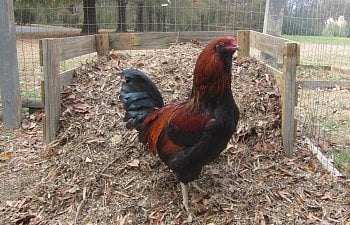
    Compost piles are excellent sources of enrichment and food. Simply create your pile of compostable material and let the chickens work it at will. The chickens will enjoy digging up the bugs and worms and will be warmed by the heat that is created from the decomposing material. Keeping a compost heap or pile in the run also reduces the amount of foraging/digging they do elsewhere in their run which will help the vegetation grow and prevent a bare muddy run. (The one pictured is a frame made from an old privacy fence that was falling down on our property filled with yard and kitchen waste.)

    Hanging cabbage, squash, lettuce, kale, spinach etc. from a string or bungee cord is a popular toy with a nutritional boost. If you can stick a skewer through it or tie a string around it then it is fair game to be hung either on the fence of the run, from the ceiling in the coop or anywhere else they might be able to play tetherball with it.


    Interactive Treat dispensers. Anything from an empty beverage bottle with holes drilled in it to cat and dog toys designed with treat dispensing holes in them. If you can fill it with some form of treat and poke holes in it so that the chickens can kick it around and peck at it to make the food come out then you have yourself a toy. There are some companies that sell chicken treat dispenser toys as well. (Pictured is a reused plastic peanut butter jar with ¼” holes drilled in it and filled with wheat seed)

    400.jpg
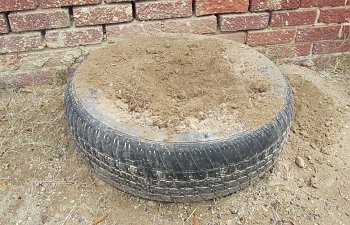
    Dust Bathing Area. Provide an area where they can dust bathe freely. Any bucket, bin, old tire or any other device filled with dirt for them to bathe in is perfect. It will encourage them to do their dust bathing in one approved location and limit the amount of holes they dig elsewhere for the purpose. You can mix in some Diatomaceous earth or wood ash as well to help deter mites etc., but it isn’t necessary. (Pictured is an old tire found on our property and filled with dirt.)

    400.jpg
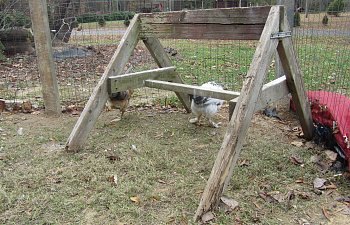
    Climbing/Perching places. The animal kingdom at large takes the term “top dog” pretty literally. Any spot that allows the head of the flock to perch above everyone else will be prized. Roosters especially prefer a spot where they can perch above the flock and crow their ownership of it to the rest of the world. Even an old tree that fell down on your property (or you cut down) can be erected in the run for this purpose. You could also build your run around an existing live tree for the purpose. Live trees also provide protection from overhead predators as well as forage and shade. (I found the sawhorse in the picture in the woods of our property. A simple sawhorse can be built out of one or two 2x4’s inexpensively, or salvaged pallets.)

    Toys for Chicks: Non-food toys are best for chicks as their nutrition requirements depend mostly on their feed unless you are an experienced chicken nutritionist or a mama hen.

    • Pet bird toys (parakeet shred a box &/or bird burrito) or any small kitten or baby toy such as fake mice, small balls, rattles, etc. The more colorful the better since chickens see color better than humans do.
    • Mirror (the unbreakable varieties for babies cribs or parakeets etc. are ideal. Better safe than sorry.) An old cd on a string would be an excellent substitute for this as well. Not only will they enjoy their reflection, they will also enjoy the rainbows that will inevitably end up on the walls etc. of the brooder area. An old cd hung in the run area not only provides entertainment but can aid in deterring hawks and other aerial predators.
    • Bin filled with sand (doubles as grit for wee ones also) or dry dirt for dust bathing.
    • Tunnel made from an empty Oatmeal container.
    • Make a chicken swing out of some rope and a large branch or a 2x4. This is great for helping them build the muscles necessary to keep them on their roosts as well as gives them a place out of the litter to warm their feet.

    Other great toy ideas that are inexpensive or free to buy or make:

    • Old stump or branch full of bugs, grubs and other creepy crawlies. This works for any piece of wood. Just leave it in one place for a few days to a week or so and let the bugs seek refuge under it – then just flip it over and let the flock go to town.
    • newspaper to shred
    • Cricket tubes (or just let crickets loose in the coop when they will be confined for an extended period of time). You can find these at most pet stores or tackle shops.
    • Sunflower heads complete with seeds
    • A post Halloween jack-o-lantern or any large squash or melon. Just drop it on the ground from high enough that it splits and let them do the rest.
    • Suet cage or fruit basket stuffed with table scraps
    • Old cd’s that are scratched beyond repair are great hung from a string along the fence of the run at or just above pecking height. If you are REALLY adventurous you can blow up a balloon, smash the cd’s and then glue them on to the balloon in a mosaic pattern and hang in the run/coop to catch the light.
    • Boiled spaghetti is a special hit. Dye the noodles different colors for added fun.
    • DIY bird feeders. Just do a Google search and you’ll come up with thousands of ideas. Just use scratch grains or BOSS or whatever else you have on hand. Molasses is a great tool for creating enough structure to hold it together enough for them to peck it to death.

    Use your imagination and have fun. If it encourages their natural behaviors of eating, scratching, pecking, bathing, flying, perching or flock socialization then it is a good toy. They don’t have to be pretty and they don’t have to cost anything. If they don’t like it you can always take it away and try again another time, or move on to the next item. Enjoy your flock!