Chick season 2022 is here! We begin with our first batch on Jan 27, 2022. Anice ChickenLady, has retired due to health issues. But Woodville Ace will be doing chicken business as usual. Join our Woodville Ace Chicken Group on Facebook, a link is in the left hand column.
On this blog you will find a list of hatch dates for birds ordered, CLICK ON "What's coming in?". To get your pre-paid special orders in call or come in to assure you get the birds you want.
There’s little doubt that you will consider buying baby chicks, ducklings or bunnies once they begin to appear in the garden centers and feed stores across the country. The cute factor is almost too much to resist! Many will fall prey to the cute little chicks and ducklings and decide to give them as Easter or Spring gifts. How can you ensure that this will be a successful endeavor for you and your family? If you are either the recipient or the giver of live animals for Easter, read on for some helpful thoughts on making it a successful journey.
Caring for baby chicks, ducks, and rabbits requires thought about how the animals will fit into your life. Those cute little balls of fluff are a lifetime commitment, at least the expected lifetime of the animal. In our more agrarian past, many people had some sort of farming or homesteading going on in their backyard. Or, they had a close by relative that lived on the farm.
Today, this is not usually the case. Many live Easter basket gifts are turned out to fend for themselves, once they grow bigger and messier. They may be turned into the local animal shelter, which is probably not equipped to care for or place grown rabbits, chickens and ducks. Chickens and Ducks are considered livestock and there may be local zoning laws not prohibiting backyard chickens in residential yards. Rabbits might be considered pets but not everyone appreciates the behavior of a house rabbit.
What to Know When Buying Baby Chicks, Ducklings, and Bunnies
Before buying baby chicks, ducklings, or baby rabbits for Easter gifts, take a moment to consider the following points. Did you plan on raising animals in your backyard? The nicely maintained patio with flower beds and lawn chairs will become a playground for your new flock once they are turned out to free range in the yard. If you don’t have a secure fence, your neighbors may receive the benefits of chickens in their backyard too. The neighbors might not enjoy free ranging chickens, so this is definitely a point to clear up before bringing home chicks. Are your children responsible? Are they old enough to learn about caring for baby chicks? Parental supervision will still be required in most cases. Many children can master the tasks of feeding watering and cleaning up a small coop. It’s still a good practice to take a look and make sure that everything was taken care of, as children can be easily distracted. Have you considered the entire life span of the chicken, duck or rabbit? Chickens can easily live 5 to 8 years. Your laying hen will provide fresh eggs for the first few years. Then the egg laying will taper off until it rarely happens. The older hens still need food and a safe place to shelter. Ducks are friendly, agreeable pets and they also have rather long lifespans. Ducks provide endless entertainment which can add to the enjoyment the family finds taking care of the animals. Rabbits are excellent pets and can provide additional income for families willing to breed or sell meat rabbits. A healthy breeding pair will require separate living quarters so you can control the breeding. Where will the animal be housed? Is this realistic? You’ll need to research topics like “what does a chicken coop need“. Have you looked into housing requirements for chicks, ducklings and rabbits? Often, the least expensive coops and hutches are not predator resistant. The good news is that after buying baby chicks, the chicks will need to stay indoors until the weather warms up consistently. Keeping a brooder pen in your house or garage for the first few weeks will give you some time to obtain a sturdy, outdoor coop and run for the chickens. This will be needed once they grow feathers and can stay warm without heat lights. Can you afford the food, and care the animals require? Do you have answers to common questions like: What do your feed baby ducks for proper growth?
Learning how to raise baby chicks is a rewarding project for families and individuals. It can bring much joy along with farm fresh eggs. Even keeping ducks in suburbia is possible and fun when some planning is used before bringing home ducklings. Make a list of what you will need for your own flock. When you visit the garden centers and farm stores this spring, you will be an informed shopper and bringing home the new fluffy family will be even more enjoyable. Are you planning on buying baby chicks this season? Janet writes about many homesteads and livestock related topics on her blog Timber Creek Farm. Her book, Chickens From Scratch, is available now.
Wild turkeys like these are the descendents of the birds pilgrims would've encountered. They haven't been tampered with genetically.
Stephen J. Krasemann / Photographer's Choice /Getty Images
When Ben Franklin suggested in 1784 that the turkey be the national bird of the United States, he couldn't have imagined the factory farms teeming with fat, dumb broad-breasted white turkeys.
Turkeys raised in today's factory farms are unrecognizable from the wild birds Franklin knew. Industry-bred birds have unusually large breasts, so disproportionate with the rest of their bodies that they often have trouble standing, walking and mating -- these turkeys rely on artificial insemination for reproduction. They begin life hatched in incubators, have their upper beaks and toenails clipped and spend their days and nights eating fortified corn in a barn full of hundreds of fellow turkeys. Their limited family tree has bred them to be dim-witted and disease-prone; they're given antibiotics to prevent a variety of ailments. Industry turkeys are abnormally fast growing, and by the time they're 12 weeks old, they're shipped off to the slaughterhouse.
There is an alternative to factory breeding: heritage turkeys, which were nearly extinct as recently as the end of the 20th century. But in the 2006 U.S. turkey census, there were about 8,800 heritage turkeys -- a big jump from the 1,300 heritage turkeys in 1997 [source: Mapes]. They're making a comeback with the help of small enthusiast groups and the Slow Food movement, and you can buy them in some specialty markets around the country. Slow Food aficionados value knowing where the food they eat comes from, how it's raised, how it tastes and how it's linked to the community and the environment. And they'll tell you a heritage bird isn't in the same league as the frozen, bowling-ball shaped turkey in your local market's freezer. These birds have rich, gamey meat that doesn't need gravy to add flavor.
The American Poultry Association lists less than a dozen heritage turkey breeds that meet its Standard of Perfection, including the standard bronze, Beltsville small white, black, Bourbon red, Jersey buff, Narragansett, royal palm, slate, white Holland and white midget.
To be considered a heritage variety, the turkey needs to meet three criteria. First, it needs to mate naturally, and its genetic legacy must also be bred naturally. Second, it must live a long and productive life outdoors, which means it must be fit and self-reliant enough to endure whatever the environment throws its way. Unlike industry-bred birds, heritage turkeys can roost, run and fly. Hens (female turkeys) typically live for five to seven years while toms (male turkeys) live about three to five years [source: American Livestock Breeds Conservancy]. And lastly, it should grow at a slow rate. While broad-breasted white turkeys are bred for their ability to mature quickly, heritage turkeys are allowed to take their time -- the development of healthy skeletons, organs and muscles can take up to 28 weeks [source: American Livestock Breeds Conservancy].
But most Americans will be sticking to the easy-to-find broad-breasted white. So when you give thanks over your turkey this Thanksgiving, remember to thank selective breeding for the bounty of white meat of which you are about to partake.
For those preparing to get their baby chicks out of the house brooder into a coop, knowing what is out there is very important. It seems we have no predators until we have something for them to eat, and the next thing we know we are preparing for battle. Once you have had your flock attacked you start learning what is needed. We have everything listed here but the weasel and badger..but we have plenty. Your most dangerous predator is your pet dog or a neighbors.
Do you know the top 12 chicken predators and how to protect your chickens from them?
Your backyard chickens can be a magnet for predators. As chicken keepers, it's important to set up a secure chicken coop to protect your flock. The first step to protecting your flock is to identify potential predators. Here is a list of the top 12 chicken predators so you can protect your backyard chickens.
1. Hawks
AudubonHawks prey on chickens and are hard to defeat without an enclosed overhead run.
2. Foxes
Antique Fox bookplate via Grandpa's MarketFoxes are well-known for their love of a chicken meal. They are more likely to strike in the evening.
3. Weasels
Via LiveScience photo by Cecil SandersWeasels (including fishers which are in the same family) are fierce chicken attackers.
4. Snakes
Photo: The Walden EffectSnakes can get into small openings and hide in coop bedding. Chicken coop construction should be sturdy, floors should be solid, and gaps in door openings should be 1/4 inch or less.
5. Unfriendly Canines
Christopher Bruno via WikipediaUnfriendly canines such as dogs, coyotes, and wolves can dig under fencing or push open unsecure sliding chicken doors.
6. Raccoons
PBSRaccoons can twist open chicken wire. Be sure to use welded wire mesh hardware cloth instead of chicken wire on window and door openings. Also, doors should latch tightly using a child-safe lock.
7. Great Horned Owls
FactzooThese sneaky predators can walk right in the coop and sidle up to a roosting chicken.
Larry Friesen via Outdoor AlabamaRats are also a threat - particularly to baby chicks and eggs.
When your chickens leave the safety of the coop during the day, it's harder to protect them from predators. Consider covering your outdoor run to protect your chickens from hawks and snakes during the daytime. If your chickens free-range, make sure they can take cover under something if a hawk flies overhead. A secure fence should help protect your flock from unfriendly canines.
If you are unsure what sort of predator is lurking around your coop, one way to find out is to watch for tracks in the snow or spread a layer of sand around your coop. Match the tracks from the predators on our list. We use a tracking book. You can also identify predators by the scat they leave behind or how they wound chickens.
Now that you know the top 12 chicken predators, you're armed with the knowledge you need to secure your flock in the safest possible coop.
Bringing home baby chicks can be an exciting learning experience, especially if you have children. While chicks don’t imprint on humans like ducklings or goslings might, they will end up being far more friendly adult hens if you spend lots of time with them as they grow. Use these tips for safely handling them, so they can get to know you better during their first weeks.
Start Slow
Keep in mind that baby chicks are likely only days old when you get them. Their bones are soft and delicate. They have intricate respiratory systems that can be easily damaged if they’re squeezed or held too tightly. Chicks also need to be kept under a heat source (set at 95 degrees F the first week, then lowered 5 degrees per week), so unless you keep your house abnormally warm, remember that any time that you take them out of their warmed brooder, you are risking chilling them.
For the day or so after you get your chicks, watch them in the brooder for as long as you want and talk to them using a soft voice, but resist the urge to pick them up. Let them get used to their new life and recover from the trip to your house. You can use slow movements and stroke them on the head or back if you wish. After a few days, try putting your hand, palm side up, into the brooder and letting your chicks inspect your fingers and hop onto your hand. Sprinkling some chick feed onto your hand can help encourage them. Talk to them so they get used to your voice.
Stay Seated
Once your chicks are comfortable with you and literally eating out of your hand, you can try taking them out of the brooder. Have small children sit on the floor and put the chicks in their lap. (A cloth or towel draped over their lap first is a good idea to keep the poop contained.) In fact, it’s actually a good idea to sit on the floor any time anyone is handling them. They can be skittish, and a fall from a few feet can easily cause injuries.
Hold Chicks Close
The best way to pick up a chick is to circle its body with your hand, your fingers loosely around the underside of its body and your thumb across its back, or scoop the chick up from underneath, cradling its belly in one hand and placing your other hand over its back. Never let a baby chick stand on your open palm, especially if you’re standing up, because they’re likely to hop off or flutter their wings and end up airborne, which will likely end in a bad fall.
Wash Your Hands After Handling
Everyone should wash their hands in warm soapy water after they’re done handling the chicks, and children should be taught not to touch their faces, and especially not to put their fingers in their eyes or mouth, to prevent Salmonella. The disease can be transmitted to humans after touching chicks that have come in contact with it. Children under 5 years old make up the majority of Salmonella cases, most likely from hand-to-mouth transmission of the bacteria. Symptoms in humans include:
cramps
diarrhea
nausea
chills
fever
headaches
Generally not fatal in healthy adults, Salmonella can result in death in the elderly, young, sick, pregnant woman and those with compromised immune systems.
Chicks Require Adult Supervision
Children under the age of five are probably too young to actually hold baby chicks, because they might accidentally squeeze them too hard, drop them, or step on them, all of which could prove fatal to a young chick. Younger children can instead be taught to gently stroke the chicks while an adult holds them. And children of any age should never be allowed to handle chicks without adult supervision.
Keep Handling Time Brief
Hands-on time with your chicks should be limited to several short sessions of just a few minutes each, several times a day. Chicks are babies and spend a lot of time sleeping. They get tired quickly and also get cold. If your chick starts peeping loudly, that’s a sign it’s cold and should be returned to the brooder. Taking out only one chick at a time is best. Chicks move fast and things can quickly get out of control if you are trying to keep track of several at once. You should handle them only in a closed room that the family pet can’t access, in case a chick does escape your grasp.
As long as you remember how fragile your new baby chicks are and take precautions, spending a lot of time handling and playing with them and offering them treats, such as chopped leafy greens, raw oatmeal or fresh chopped herbs (be sure they have chick grit to help them digest it), will go a long way towards ultimately having a friendly flock of backyard pets.
Bantam Chickens: Breeds, Egg Laying, Size and Care Guide
Posted by The Happy Chicken Coop on Posted In: Breeds
Bantam Chickens are most suitable for small backyards where space is premium.
You can easily fit two bantams into the space required by one standard bird and since they like to fly, building up will accommodate them well.
They may be small but they are bursting with personality and happiness – of course, I may be biased since I do have a small flock of Barbu D’Uccles!
In the article below we will explain the different types of bantams, how to care for them, their egg laying ability and much more.
What is a Bantam Chicken?
A bantam chicken is a miniature version of a regular chicken. They can vary from one half to two thirds the size of regular birds. Bantam Cochin Chickens
In total the American Bantam Association lists over 400 varieties of bantam birds.
The origin of the word ‘bantam’ is from the seaport of Bantan, Indonesia.
When sailors stopped into the port for fresh supplies of food and water, they were impressed by the local chickens which were smaller than the chickens back home. The word – Bantan – was corrupted into Bantam in general English and so small chickens became known as bantams.
Types of Bantam Chickens
Strictly speaking there are three types of bantam chicken.
There are ‘true’ bantams; these have no large fowl counterpart. They are naturally occurring with no input from mankind. Breeds: Nankin, Sebright and Rosecomb.
Miniaturized bantams – these were ‘made’ from a standard breed of choice such as Rhode Island Red, Cochin or Orpingtons.
Developed bantams – these are small breeds that have been further developed with some help from mankind. They have been around for so long that the origins are sketchy at best. Such breeds are: Belgian, Pekin (Cochin) and Japanese.
The developed bantam breeds can be a bit confusing really. For example the Barbu D’Uccle – it has no large fowl counterpart, so it is a true bantam. However, the breed was created around 1903 by Michael Van Gelder of Uccle, Belgium and was created by crossing two (maybe more) bantam breeds, so it is also a developed breed.
To avoid confusion among folks the difference between miniaturized and developed is usually ignored with many people saying there are two types of bantam – but now you know better!
How to Care for Bantams
In most respects, bantams do not generally require anything different from standard breeds.
Since they are small they have a higher metabolic rate, so several of these little birds do feel the cold more than larger hens. Japanese and Dutch bantams especially are noted as not being cold tolerant.
The usual requirements for housing remains; dry and draft proof. All poultry require housing that is sized for the number of birds that will be living in it.
If you remember, large fowl need 4 square foot of coop space and 8 square foot of run/ per bird. Bantams require slightly less space. Several sources state 1sq.ft/bird, but 2sq.ft is preferred in the coop with 4sq.ft in the run.
Bantams take a lot less room than their larger counterparts already! If you can provide lots of perches at different heights, maybe even a small tree and some bushes, they will make excellent use of them.
It goes without saying that they need the appropriate food and water. Supplements would include vitamin/electrolyte powder monthly, grit and calcium, plus any suitable scraps for them.
A bantam will eat roughly 1lb feed/month – you are saving on your feed bill dramatically.
Bantams are usually great flyers! If you plan to keep them in a coop, make sure they have high perches and places they can fly up to if they want to. If you wish to keep them confined to that area the run will need to be covered. This will also prevent predation by hawks or owls.
If you decide to mix your bantams in with standard breeds, make sure they aren’t getting picked on because of their size.
Mine mix in with the standards and I have found them very adept at evading and maneuvering between the larger girls. They will readily fly up and out of the way if they feel threatened in any way.
These diminutive little powerhouses can live up to 10-15 years, but generally their life expectancy is around 5-7 years.
Special Care for Bantams
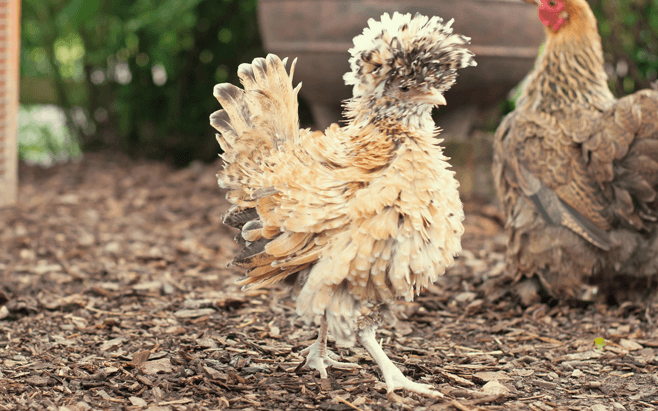
Polish Frizzle BantamSeveral varieties of bantam are feather legged or ‘sablepoots’. These types of bird require their pens to be relatively mud/muck free, otherwise the foot feathers get incredibly crusted and dirty.
Amending the base of the run can be fairly straight forward. If it is prone to muddiness, add some pebbles or construction sand to the area. When the area is dry enough try seeding with grass, plant a couple of shrubs if you have the space too.
In the early spring, I usually add two or three large buckets of mulch to the area around the doors etc. This stuff will break down nicely, provide some ‘scratch worthy’ dirt and keep feet a bit cleaner.
If the feet get crusted with dirt and poop, a foot bath is in order. Standing the bird in warm water and gently working at the feathers can be relaxing for the bird and you. Remember, these are small birds so it shouldn’t become a wrestling match as it does sometimes with the standard birds!
The foot feathers can also get broken fairly easily and cause a good deal of bleeding. The good news is that with some baking powder or styptic and some firm pressure on the area the bleeding will stop.
Feather footed birds are also prone to scaly leg mites. These nasty little pests can set up shop quickly and remain unnoticed for some time because of the feathering. I check my birds nightly when they go to roost but checking them once a month should suffice.
Bantam Egg Production, Broodiness and Disposition
Bantam eggs are of course, smaller than standard eggs; roughly half the size of standard eggs. The ratio for using them in cooking is 3 bantam eggs for every 2 standard eggs.
Bantams tend to get a bad rap for laying. Admittedly it was about eight months before mine started to lay, but they have been pretty consistent since then. This past winter we have certainly had more bantam eggs than standard – thankfully!
Bantams of standard fowl tend to lay slightly larger eggs and are more prolific than the true bantams.
Some go broody others not, but the broodies defend their eggs and chicks fiercely and they make great mothers – not even standard hens will mess with a bantam broody! Many folks keep one or two bantam broodies to hatch out their standard eggs because they are so reliable.Obviously a bantam cannot cover as many eggs, but that doesn’t mean they won’t try!
They generally have a sweet temperament and are friendly to humans and chickens alike. Roosters can be sweet, but some can also be a bit aggressive especially during the mating season.
As always, some breeds of rooster are better than others, so research your chosen breed carefully.
Summary
No room for large chickens? Want something different that will make you smile? Look no further than bantams.
There is a large variety to choose from, whether you want a ‘mille fleur’, speckled, barred or plain – there is a Bantam to suit your taste.
They are always interesting to watch, with some varieties such as the Barbu D’Uccles you can have whole conversations with!
They are joyful, curious and entertaining creatures. If I could only have one type of bird it would be bantams.


 y
y