Search This Blog

Monday, February 25, 2019

HOW CHICKENS MAKE EGGS

How a Chicken Makes an Egg and
Why Some Eggs are Unusual


As a backyard chicken-keeper, it is not uncommon to find irregular eggs. Do not worry unnecessarily about the occasional strange-looking egg; take a picture of it, discuss it at the water cooler next day and get a good chuckle out of it. They happen, and the vast majority of the time they do not indicate any cause for concern.
Before we get to all the pretty, funky and bizarre egg pictures, it’s important to understand how a hen’s reproductive system is supposed to work when firing on all cylinders.
How a Hen Makes Eggs Odd Eggs Array on Hydrangea
Here's the deal with a hen's reproductive system: a female chick's ovary contains all of the ova it will ever have when it's hatched. The ovary begins to convert ova to egg yolks when she is mature. With the right lighting conditions exists, hormones stimulate ova to develop into yolks. Yolks are released from the ovary into the oviduct when they reach the right size and travel down the oviduct to acquire their whites, membranes, color (if any) and shell. An egg requires approximately 25 hours to complete the addition of the
egg white, the shell membranes, and the shell. Soon after an egg is laid, the process starts again.
A hen's reproductive system consists of an ovary and oviduct.How a Hen Makes Eggs Odd Eggs Reproductive System Anatomical Drawing

The following is an actual hen's reproductive tract.1 I have labeled the functions that occur at different junctures along the way. If fertilization is to occur, it happens in the infundibulum, which is the area immediately to the right of the ovary (the black line is running through it in this photo). The infundibulum is a muscle that essentially engulfs the ovum (yolk) when it is released. The sperm waits in the infundibulum and has a narrow, 15-18 minute window of opportunity in which to fertilze the ova there.
How a Hen Makes Eggs Odd Eggs Reproductive Tract of Hen at Necropsy
 How a Hen Makes Eggs Odd Eggs Parts of Egg Ilustrated
FERTILE AND INFERTILE EGGS
How a Chicken Makes an Egg and Egg Irregularities Infertile Egg


INFERTILE EGGS: Infertile eggs are ones that have not been inseminated by a rooster, and as such, will never hatch chicks. All eggs contain a concentration of cells on the yolk called the blastodisk, which is identified by its light color and irregular shape. When fertilized, the blastodisk becomes known as a blastoderm.


How a Chicken Makes an Egg and Why Some are Unusual Fertile Egg

How a Chicken Makes an Egg and Why Some are Unusual  Assortment of Egg Colors


EGG IRREGULARITIES
DOUBLE YOLKS:Commonly occur in new layers when the yolk release is mistimed and two yolks travel down the oviduct together. Some hens are genetically predisposed to laying double-yolked eggs.


How a Chicken Makes an Egg and Why Some are Unusual  Double Yolk
How a Chicken Makes Eggs and Egg Irregularities  Double Yolked Egg 90g

How a Chicken Makes an Egg and Weird Eggs Triple Yolk


NO YOLK: Also known as rooster eggs, wind eggs, dwarf eggs, rooster eggs or fart eggs (I just report the news, folks, I don't invent it.). Commonly occur with new layers when reproductive system isn’t quite synchronized yet.
Eggs without yolks can occur in older layers when a piece of tissue from the reproductive tract frees itself, fooling the hen’s reproductive glands into treating it like a yolk, creating an egg out of it. The little piece of tissue is visible in this photo:


How a Chicken Makes an Egg and Weird Eggs No Yolk


NO SHELL OR THIN SHELL: I call soft-shelled eggs ‘rubber eggs” as the membrane is soft and pliable. These eggs are commonly produced by new layers, caused by either an immature shell gland or a glitch in the reproductive system when the
shell was not properly added in the shell gland. Can be caused by stress or poor nutrition. To find them occasionally is no cause for concern, to find them regularly can indicate a calcium, phosphorous or vitamin D deficiency.


How a Chicken Makes an Egg and Odd Eggs Thin Shelled No Shell Eggs


ODD SHELL SHAPE OR TEXTURE: (Includes too large, too small, flat-sided, 'body-checked' eggs) I
affectionately refer to these as 'mutant eggs.'
In new layers, an immature shell gland can cause odd shell shape and is most often of no concern. In senior layers, oddly shaped eggs can result from stress or, if they are a regular occurrence, a defective shell gland. Misshapen eggs can also be caused by infectious bronchitis or egg drop syndrome, both of which are cause for alarm.
Shells with wrinkles or ‘checks’ in the shell are known as ‘body check’ eggs. These eggs have been damaged while in the shell gland from stress or pressure put upon them. These eggs are repaired in the shell gland, resulting in checks/wrinkles. Some of the eggs that follow fall into several of these categories.


How a Chicken Makes an Egg and Unusual Eggs Pimpled Egg
How a Hen Makes an Egg and Odd Eggs Wrinkled Egg


ROUGH-SHELLED OR PIMPLED : Egg shells can have different textures causes by a range of things from excess calcium intake (pimpled eggs) to double-ovulation, disease, defective shell gland or rapid changes in lighting conditions (sandpaper eggs). As long as these types of eggs are found infrequently, there is no cause for concern.


How a Hen Makes an Egg and Odd Eggs Flat Side Egg2


FLAT-SIDED: Can occur in new layers due to stress or disease. The egg is kept too long in the shell gland, resulting in a flat side with wrinkles. Can also occur when a mis-timed, second egg proceeds down the oviduct, bumping into and resting alongside the first egg.
UNUSUALLY LARGE: Eggs of unusually large size ordinarily contain double yolks, and the hen's reproductive system accommodates for the anomaly by working overtime to generate these monstrosities.


How a Hen Makes an Egg and Odd Eggs Huge Egg in Carton
How a Hen Makes Eggs and Unusual Eggs Large Blue Egg


The average extra-large egg weighs 64 grams and a jumbo egg weighs 71 grams. The two largest eggs I've ever had were 90 and 95 grams.


How a Hen Makes Eggs and Unusual Eggs Carton of Colorful Eggs


ABOUT SHELL COLORING: All egg shells start out as white eggs. Colored eggs have their pigment added to the shell a little later in the formation process.


How a Hen Makes Eggs and Unusual Eggs Colorful Eggs


BROWN EGGSHELLS contain the pigment protoporphyrin, ( a by-product of hemoglobin) which is found only on the surface of the shell. Brown pigment is applied in formation of the last layer of the egg, the bloom or cuticle. The brown pigment can be rubbed off easily and does not color the inside of the shell.


 How a Hen Makes an Egg and Unusual Eggs Green Speckled Egg


BLUE AND GREEN EGGSHELLS are produced by the pigment oocyanin, (a by-product of bile formation). The color is applied early in the shell's formation and penetrates the entire shell. The blue coloring cannot be rubbed off.
White egg shells have no pigment at all. Uneven, striped, spotted or speckled shell coloring results from the uneven distribution of pigment as the egg passes through the oviduct.


How a Hen Makes an Egg and Unusual Eggs Speckled Striped Egg


How a Hen Makes an Egg and Unusual Eggs Camoflage Green Egg


How a Hen Makes an Egg and Unusual Eggs Speckled Brown Egg


How a Hen Makes an Egg and Unusual Eggs Blue Striped Egg


EGG WITHIN AN EGG: This extraordinarily rare situation occurs when an egg that is almost ready to be laid reverses engines into the reproductive tract, meeting up with another egg-in-progress. It gets another layer of white/albumen and a new layer of shell before being laid. The cause is not known.


How a Hen Makes an Egg and Unusual Eggs Egg Inside Egg Cast Iron Pan


How a Chicken Makes Eggs and Egg Oddities Egg Inside Another Egg


How a Hen Creates an Egg Egg Oddities Egg Inside an Egg


BLOOD SPOT: When a little blood from the ovary joins the yolk down the reproductive tract, a blood spot will be seen in the egg. This usually occurs in older hens that have a genetic predisposition to them or that have a vitamin A deficiency. While it can occur randomly in any egg, less than one percent of all eggs will contain a blood spot.


How a Hen Makes Eggs Unusual Eggs Blood Spot in Egg


The preceding information is provided as a general guideline to understanding some egg irregularities and some of the more common causes of them. It is not intended as an exhaustive review of the subject. If you have some concern that your hen may be ill or consistently produces irregular eggs, you should consult an avian vet or perform in-depth research based upon your individual circumstances.
1Anatomical illustrations and photo reproduced for educational purposes, courtesy of Jacquie Jacob, Tony Pescatore and Austin Cantor, University of Kentucky College of Agriculture. Copyright 2011. Educational programs of Kentucky Cooperative Extension serve all people regardless of race, color, age, sex, religion, disability, or national origin. Issued in furtherance of Cooperative Extension work, Acts of May 8 and June 30, 1914, in cooperation with the U.S. Department of Agriculture, M. Scott Smith, Director, Land Grant Programs, University of Kentucky College of Agriculture, Lexington,and Kentucky State University, Frankfort. Copyright 2011 for materials developed by University of Kentucky Cooperative Extension. This publication may be reproduced in portions or its entirety for educational and nonprofit purposes only. Permitted users shall give credit to the author(s)
and include this copyright notice. Publications are also available on the World Wide Web at www.ca.uky.edu. Issued 02-2011

Monday, February 18, 2019

CHICKEN MEETING FEB 21ST

COME ON DOWN TO THE
WOODVILLE ACE CHICKEN MEETING


FEBRUARY 21ST
THURSDAY
6:30 PM


GUEST SPEAKERS
DANNY SMITH FROM PURINA MILLS
ANICE THE WOODVILLE ACE
CHICKEN LADY


Image result for FREE CHICKEN IMAGES


DISCOUNTS OFFERED AFTER THE MEETING
GIVE A WAYS


Thursday, February 14, 2019

VALENTINE SPECIAL!

VALENTINE'S DAY SPECIAL
BUY  10 CHICKS GET 2 FREE
Image result for CHICK VALENTINE PHOTO
WE HAVE A BROODER FULL OF BABY CHICKS, 2WEEK OLD, 1 WEEK OLDS AND 2 DAY OLDS...GIVE YOUR SWEETY A BUNCH OF CHICKS.

Monday, February 4, 2019

Rhode Island White Chicken


Introducing the bird of the week
Rhode Island White Chickens

Top of Form


Rhode Island White Chickens Details

Thought very similar, Rhode Island Whites are a completely different breed from their more popular counterpart, the Rhode Island Red. They do both originate in the state of Rhode Island, but the Rhode Island White was developed 50 years later. 

Rhode Island White Chickens are hardy and even-tempered birds. They are all white with bright red wattles and single combs. They have yellow legs and feet. 

Rhode Island White Chickens are adaptable, truly all-purpose chickens. They do just fine in confinement as well as in free-range environments. They get along with other chickens. They are an overall great barnyard bird.

Production: Like their red counterparts, Rhode Island White Chickens are dependable and solid egg layers. One notable Rhode Island White Hen in Missouri has been recorded to have laid 306 eggs in one year. Typical egg laying numbers are 240 to 250 eggs per year. Eggs are brown. Rhode Island Whites are often recommended as winter-layers as they lay better than many other chickens during the short days of winter. They do not tend to go broody.

Rhode Island White Chickens were also bred as meat birds. They have deep, well-developed breast meat and mature quite early. The meat quality is considered excellent.

Temperament: The adaptability and easy going nature of the Rhode Island White makes these birds a solid choice for almost any farm or homestead. 

History: Rhode Island White Chickens were developed by efforts started in 1888 by Poultry farmer, John ALonzo Jocoy, in Peacedale, Rhode Island. His breeding program consisted of mixing rosecomb White Leghorns with Partridge Cochins and White Wyandottes. As the breeding developed, the birds took on more of the sturdy and brick-like shape of the Rhode Island Red and looked less and less like Leghorns or Wyandottes. The rosecomb Rhode Island White Chickens were admitted to the APA Standard of Perfection in 1922. Although the breed has always had a loyal following, it is still quite rare and has never reached the popularity of the Rhode Island Red. This is surprising because except for its white coloring this breed is just as productive and hardy. 

APA Class: American

Conservation Status: Watch

Body Type: Rhode Island White Chickens are shaped very similarly to Rhode Island Reds - they are sturdy and well-put-together with a longish-shaped, brick-like body. They have strong-looking heads with medium-sized wattles and a single combs. They do well in winter weather. 

Weight: Cockerel 7.5 lbs, Pullet 5.5 lbs

Monday, January 28, 2019

Ameraucana vs Araucana Chickens

All About Ameraucana Chickens

These Facts About Chickens Will Help You Distinguish Between True Ameraucanas and Other Chicken Breeds

ameraucana-chicken


By John W. Blehm – To say that Araucana, Easter Egg, and Ameraucana chickens are the same would be like saying Cornish, Brahma and Sex-Linked brown egg layers are the same. The chickens in the first group all possess the gene for blue shelled eggs and the birds in the second group produce brown shelled eggs. Having one or even several traits in common does not make two different breeds the same breed.
Araucana and Ameraucana chickens are completely different breeds just as Cornish and Brahma chickens are different. Each breed is different from all the others and the differences are listed in the American Poultry Association’s Standard of Perfection. We generally refer to it as the APA Standard and it tells what characteristics or traits are needed to classify a chicken under any of many different recognized breed descriptions. The Standard is the final word in the world of exhibition poultry in North America.


Keep Your Laying Hens Strong and Healthy

Our friends from Purina® wrote this free guide to help you enjoy farm fresh eggs for years. YES! I want this Free Report »

An Araucana chicken has ear tufts (not the same as muffs) and is rumpless, meaning it doesn’t have a tail.  Ameraucana chickens have muffs and a tail. Both breeds have pea combs and lay blue eggs, but have just as many differences as similarities or common traits according to the Standard.
What is referred to as an Easter Egg chicken or Easter Egger is not a recognized breed, but rather a hybrid chicken that possesses the gene for blue eggs. These birds can be of any physical description. As far as “Americana” chickens go there is no such breed. It is just that many commercial hatcheries can’t spell “Ameraucana” and try to pawn off their mongrel chickens as such. When you see Araucana/Americana chicks for sale you can bet they are really Easter Eggers. Generally speaking, these are fine chickens for the backyard but would be disqualified at an APA sanctioned poultry show. Many novice poultry fanciers have fallen for the false advertising of these hatcheries and been very disappointed. Some hatcheries now have disclaimers saying their Araucana/Americana chickens are not for exhibition yet they continue to advertise them using APA breed names.
Araucana and Ameraucana chickens are both relatively new chicken breeds. The APA accepted Araucanas as a breed in 1976 and Ameraucana chickens in 1984. Before Araucanas were accepted and became a standard breed the term Araucana was used interchangeably with Easter Egger to describe all chickens that possessed the blue egg gene. Today some people still mistakenly get it wrong and that is partly due to all the misinformation and outdated information on the Internet and elsewhere.


A Bantam Ameraucana Black pullet. Photo by Michael Muenks, Missouri.

Myth Busting About Ameraucana Chickens

While on the subject of misinformation let’s try some myth busting. For many decades some commercial hatcheries promoted “egg facts” about “Araucana” eggs as being lower in cholesterol and higher in nutritional value than other chicken eggs. Even though those claims were proven false over 27 years ago many people still believe them to be true. Remember that Araucana, back in the day, meant any chicken with the blue egg gene. Heck, those same commercial hatcheries even claimed that “Araucana” meat had a taste similar to quail! Imagine that-chicken that doesn’t taste like chicken.


An attractive basket of blue eggs from large fowl Ameraucana wheaten hens. Photo by Barbara Campbell, Tennessee.


An attractive basket of blue eggs from large fowl Ameraucana wheaten hens. Photo by Barbara Campbell, Tennessee.
Oh, and how about those pink, green, olive drab and gold colored eggs that the catalogs advertised? The reason the egg colors vary so much is that the birds are of mixed parentage. There are only two true eggshell colors, blue and white. The gene that makes blue egg shells is dominant over the gene for white eggs. Brown eggs are really white eggs with a brown tint or coating. Green eggs are really blue eggs with a brown tint or coating. Just as there are many shades of brown eggs there are many shades of green eggs. You can tell if an egg is truly white or blue when the inside eggshell color matches the outside. Blue chicken eggs are not a robin’s egg blue color. They are a light pastel blue. Getting that good true blue color is still a problem that dedicated Ameraucana breeders are trying to get right especially in some of the large fowl varieties.


Large fowl Silver Ameraucana chicks


Which came first the Araucana or the Ameraucana? Actually, since both are now legitimate names of official APA breeds, let’s say the Easter Eggers came first. They came to this country as mongrel chickens and were bred to other types of chickens. Over the past several decades some breeders bred them to look the way they wanted. Some bred for tufted and rumpless characteristics, some bred for muffs and tails and others bred for whatever they wanted. Araucanas were not developed from Ameraucanas and Ameraucanas were not developed from Araucanas. They were both bred up from Easter Eggers or mixed breed chickens.
The tufted and rumpless breed was officially accepted first into the Standard. They took the name Araucana. There was still a large following breeding the muffed and tailed blue egg layers, so they had to come up with a new name for their breed that they had also referred to as Araucana up to that time. They organized a breed club and chose the name Ameraucana over American Araucana by a 9 to 5 vote.
Bantam Ameraucanas and large fowl Ameraucanas actually add up to two standard breeds of Ameraucana chickens. The big difference between the two is size. Bantams are just miniature versions of large fowl chickens or maybe large fowl are big versions of bantams. Either way the APA recognizes the same eight varieties in each breed. They are: black, blue, blue wheaten, brown red, buff, silver, wheaten, and white. Some breeders are working on new varieties such as lavender and black gold.

Wednesday, January 23, 2019

Chicks ARE Here!!!

Few changes this year appeared when our first order came in one day early!
Image result for baby chick


NEW! Our COMMON chicks that are listed on the blog (left column) are NOW $3.50.


We have not yet ordered our rare birds, but due to price increase from the hatchery they will also reflect a price change TBA.


NEW! Mount Healthy has changed their Easter Egger breed (lay colored eggs)  from Auracanas to Americanas. Slight difference in breeding but they look much the same.


.******************************************************************************


ALL COMMON chicks we order from Mount Healthy Hatchery are PULLETS, meaning they are 90% female, sexed at the hatchery.


Most Rare chicks are STRAIGHT RUN, meaning they are not sexed at the hatchery. With Straight Run you are more likely 50/50 female to male.


We do not sex chicks here at Woodville Ace Hardware, your guess is as good as ours.

Monday, January 14, 2019

Need a brooder for your new chicks?

How to Build a Brooder


Shutterstock Photography

Raising chicks is infinitely easier than incubating eggs, but there is still much more to it than just plopping them in a coop. They need a toasty-warm mini-coop – a brooder – to nurture them into toddlerhood. If they had a mother of their own, the chicks would crowd under her feathers at night for warmth, and she would show them how to forage and keep them safe by pecking viciously at any predator that came lurking. There are many ways to build a brooder, but they all have to fulfill the basic needs of an orphan chick for the first six weeks of its life: food, water, warmth and protection.

Step 1 – Build a Container

Build is a relative term here. Many people raise chicks in a cardboard box. Play pens, kiddie pools, rabbit hutches, aquariums, plastic totes and other items likely to be found in a garage, barn or basement will suffice. You can build a custom chick mansion with private bedrooms for each one if you want, but the general rule of thumb is to provide at least one square foot of space per chick. For the first few weeks a small fraction of that space is fine, so one option is to start small and add on later.
The container needs to be at least 12 inches tall for chicks in weeks one to three, but by the time they are six weeks old the walls should be 24 inches high to keep them from hopping out. Or, you can add a lid. A lid is a necessity if there are pets or other creatures that may pose a threat to your baby chicks. Chicks need fresh air, however, so the lid needs to be completely breathable – hardware cloth or window screen stapled to a wooden frame is an easy way to go.
The brooder needs to be out of the elements so the chicks are warm, dry and safe from nighttime predators. A barn, garage or your living room are all fine options. You can also place the brooder inside the chicks’ future home – the coop.


Step 2 – Outfit the Brooder

Pine shavings are the bedding of choice for baby chicks. The essential oils in cedar shavings can cause respiratory distress and newspaper is hard for them to walk on when they’re little.
Spread an inch or two of shavings on the floor of the brooder and set up a watering and feeding station at one end. There are various DIY options for chick waterers and feeders, but the basic models only cost a few bucks at the feed store. Nipple-style waterers are highly recommended because the chicks can’t foul them with feces – good hygiene is critical to keeping chicks healthy.
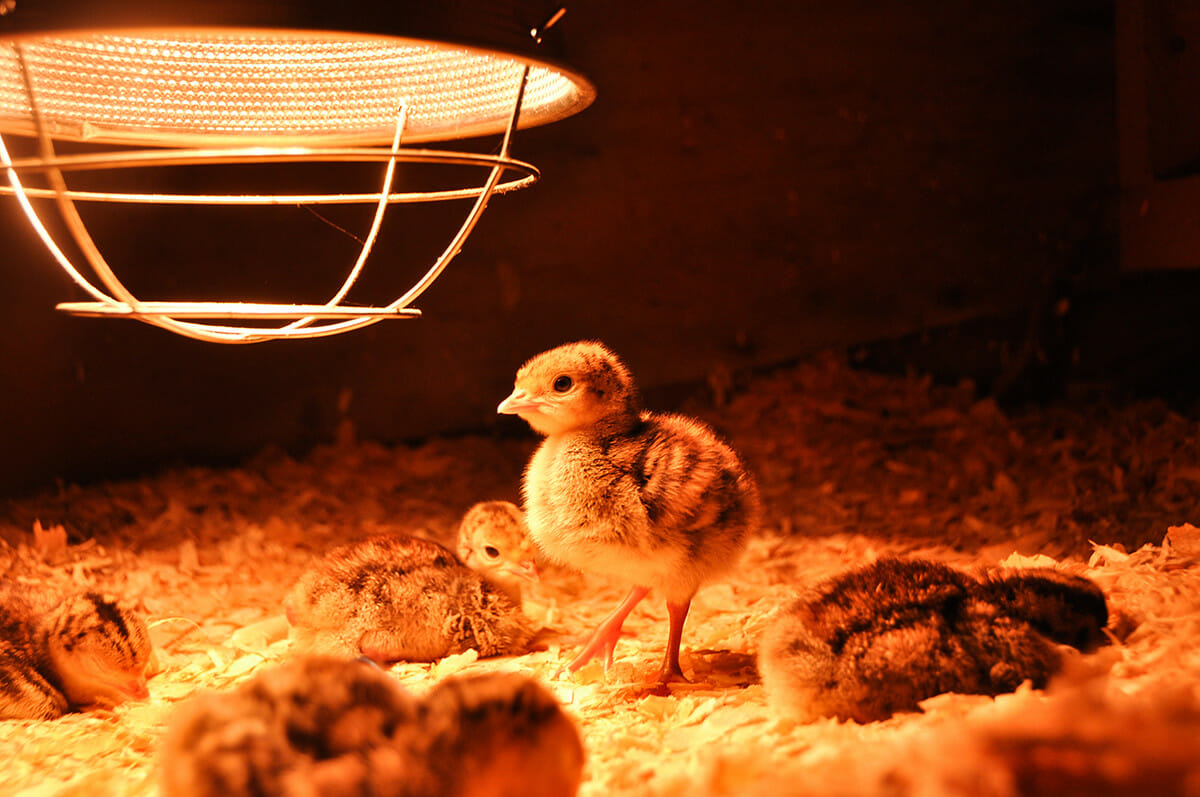
On the other end of the brooder, set up a heat lamp. If you have your chicks in the living room where it’s 65 degrees at night, a 100-watt incandescent bulb in a clamp-on utility light (the kind with a metal reflector) will provide enough warmth. If they’re in a barn, garage or another location that gets chilly, a heat lamp is in order. These special bulbs can be found at feed stores or ordered online.
The height of the bulb may need to be adjusted anywhere from 12 to 36 inches above the bottom of the brooder to maintain the optimal temperature for the chicks. One easy way to accomplish this is to hang the light fixture by a chain attached to a hook above the brooder.
If hot bulbs in close proximity to a cardboard box filled with wood shavings and baby chicks makes you nervous (it definitely qualifies as a fire hazard), consider an EcoGlow brooder heater, which are also designed to save energy.


Step 3 – Care for Your Chicks

Chicks need to be at a constant temperature of around 95 degrees for the first week of their life. Mail-order chicks are almost always less than 48 hours old; if you get your chicks at a feed store, ask how old they are before bringing them home. Adjust the height of the bulb and use a thermometer to measure the temperature at the bottom of the brooder to get it into the proper range before the chicks arrive.
Dip the beak of each chick into the water source as you put it in the brooder so it knows where to go when it’s thirsty.
The chicks will tell you if they are too hot or too cold: if they are huddled on top of each other directly under the bulb, move the bulb closer to warm them up; if they are pushing against the opposite wall of the brooder away from the bulb, it’s way too hot. Chicks milling about throughout the brooder is a good sign that the temperature is just right.
Lower the temperature of the brooder by about 5 degrees each week. As the chicks’ feathers fill in, they are more tolerant of cold, but they are also prone to overheating, so it’s important to keep the temperature just right.
Food and water should be available at all times. Chicks need a special ‘starter feed‘ during their time in the brooder. Starter feed has a crumbly texture, but gets clumpy when moist. If this occurs, clean out the feed tray and add fresh food to avoid mold developing.
It’s a good idea to clean out the food tray every few days anyway because the chicks can’t reach every bit and it will start to get stale. Waterers should be cleaned out daily (unless you’re using nipple waterers, which don’t require cleaning), and the bedding should be refreshed every other day by scooping out the top layer and adding shavings.
Once the chicks are six weeks old, their feathers should be filled out and they are capable of tolerating cool nighttime temperatures – so it’s time to transfer them to the coop. To smooth the transition, move the heat source, feeder and waterer into the coop for the first few days, and set up an adult-size feeder and waterer.